Cornish Hevva Cake (sometimes known as Heavy Cake)
Despite the unprepossessing name that Cornish Hevva Cake is sometimes given, this lightly fruited bake is not particularly ‘heavy’. It is, however, absolutely delicious. The bake falls somewhere between a sweet scone and a light egg-free fruit cake. As with many traditional bakes, Tesen Hevva (its Cornish name) is very easy to make.
St Piran’s Day
Well Cornwall’s national day, St Piran’s Day, is here again and I’d like to wish all my Cornish friends and readers a Happy Gool Peran. Cornish Hevva cake is one of my favourite Cornish bakes, so it seems a fitting and tasty way to celebrate the day.

St Piran is one of the patron saints of Cornwall and also of tin miners. The 5th of March used to be a feast day and holiday for ‘tinners’. Today you’ll find Saint Piran’s Flag flying high all over the county, along with various processions, dancing, music and poetry. You might even be able to indulge in the odd pasty or two.
Cornish Hevva Cake
Cornish hevva cake is an old Cornish recipe. It was traditionally made by fisherman’s wives to welcome their husband’s home from a successful fishing trip. A cliff top ‘huer’ looked out for shoals of pilchards (silver sardines). When he or she spotted a shoal, they’d alert the fishermen by shouting ‘heva, heva’ and guide them to it using gorse branches.
Heva is a derivation of the Cornish ‘hes va’, which means something like ‘there’s a shoal here’. As soon as the womenfolk heard the cry, they’d start baking their ‘tesan hevva’ to serve hot with a ‘dish of tay’ when their men arrived home.
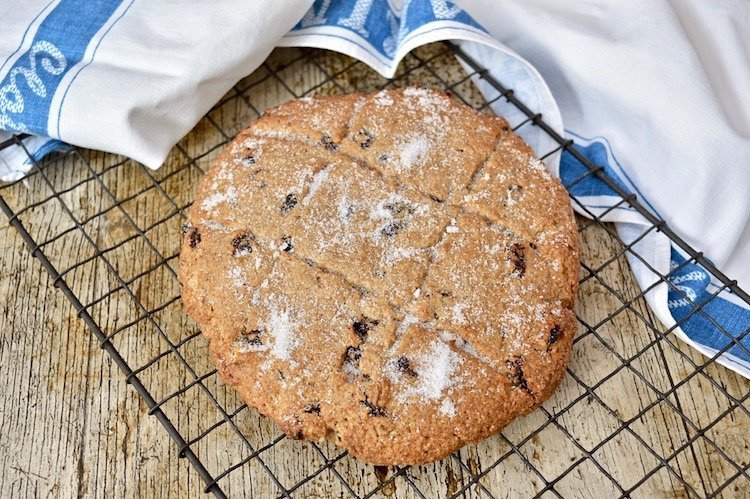
Heva became hevva and later morphed into the anglicised version ‘heavy’. It’s really not a heavy cake at all, but neither is it light and spongy. It’s a simple and frugal bake with no eggs or spices, just flour, fat sugar and currants. The main thing that distinguishes this bake from similar ones across the country is a criss cross pattern marked on the top of the cake to represent a fishing net.
To Leaven or Not to Leaven?
There’s much controversy as to whether baking powder should be used in a Cornish hevva cake. Some say yay and some say nay. I say that traditionally, ‘tesan hevva’ is likely to have been an unleavened cake. But when baking powder became widely available in the mid 19th century, I expect it found its way into all sorts of bakes, including Cornish hevva cake.
My version is made with wholemeal spelt flour and a little baking powder. I’m continuing the tradition of being untraditional.
A traditional Cornish hevva cake would be quite large. This is a modest version which will give six decent portions. But if you have a crowd to feed, just double or even triple the quantities. If you make a larger cake, you’ll need to bake it for a bit longer than the recipe states.
Dried Fruit
I usually have a bag of currants in the cupboard, but in the middle of making this Cornish hevva cake, I was surprised and annoyed to find I had none. I had to use raisins instead. Currants used to be the cheapest option when it came to dried fruit, although they seem to be just as expensive as sultanas and raisins these days. I’ve seen a few modern recipes that contain raisins, but traditionally it would have been currants.
Mixed Peel or Lemon Zest?
Mixed peel is another of those odd ingredients that unfussy CT doesn’t like. Beetroot and semolina are the other two. I like cakes that contain mixed peel, but I’m more than happy to substitute it for lemon. I’ve seen family recipes for Cornish hevva cake that contain one or other of these ingredients and some that have neither. I guess it depended on what was available at the time. That’s usually how I cook, anyway.
If you’re feeling really adventurous, you could have a go at making your own candied peel. It’s way better than shop bought.
How to Make Sour Milk
Sour milk is great for baking. It reacts with baking powder to create lots of bubbles. This in turn helps to raise and lighten cakes, soda bread, scones and pancakes. When we were lucky enough to have a supply of raw milk, I used to have a steady flow of sour milk. Raw milk if left a while, sours naturally.
I find it’s a bit hit and miss with pasteurised milk, occasionally it sours if left long enough, but more often than not it just goes off. You can tell by the smell and taste of the milk. If it smells rotten, it probably is. But if it’s just gone sour, it’s absolutely fine for baking.
These days I tend to use kefir when a recipe calls for sour milk or buttermilk. I have an almost endless quantity of kefir and it works very well. Needless to say that’s what I used instead of sour milk in this Cornish hevva cake. However, if you don’t have any kefir to hand, it’s incredibly easy to make a ‘cheat’s’ version of sour milk.
Just add 1 tbsp of lemon juice or vinegar to a measuring jug. Top it up to 250ml with milk. Stir and leave at room temperature for 5 minutes. By then it should have curdled and thickened slightly, which is just what you want. This works as a buttermilk substitute as well.
Other Recipes for Cornish Bakes You Might Like
- Cornish sea salted caramel brownies
- Cornish splits
- Fairings (spiced ginger biscuits)
- Liskeard bun (vegan)
- Saffron buns
- Squash chill chard feta pasties
- Vegetarian lardy cakes
Keep in Touch
Thanks for visiting Tin and Thyme. If you make this delicious Cornish heavy cake, I’d love to hear about it in the comments below. And do please rate the recipe. Have you any top tips? Do share photos on your preferred social media site and use the hashtag #tinandthyme, so I can spot them.
For more delicious and nutritious recipes follow me on Twitter, Facebook, Instagram, Flipboard or Pinterest. And don’t forget to SUBSCRIBE to my weekly newsletter. Or why not join the conversation in our Healthy Vegetarian Whole Food Recipes Facebook Group?
If you’d like more fruit cake recipes, follow the link and you’ll find I have quite a lot of them. All delicious, of course.
Choclette x
Cornish Hevva Cake. PIN IT.
Cornish Hevva Cake – The Recipe
Cornish Hevva Cake (aka Heavy Cake)
Ingredients
- 175 g wholemeal spelt flour (6oz)
- ½ tsp baking powder
- 1 pinch sea or rock salt (I used Himalayan pink rock salt)
- 75 g unsalted butter (2 ½ oz)
- 75 g golden caster or granulated sugar (2 ½ oz)
- 60 g currants (2oz) (can substitute with raisins or sultanas)
- 60 ml kefir, buttermilk, sour milk or watered down yoghurt (I used kefir)
- 1 lemon zested (can substitute with 30g (1 oz) mixed peel)
Instructions
- Turn the oven on to 180℃ (350℉, Gas 4).
- In a large bowl, rub the butter into the flour, baking powder and salt with your fingertips until you get the consistency of rough breadcrumbs. Don’t be too particular about this, bits of butter will help to give a flaky texture to the cake.
- Stir in the sugar, lemon zest or peel and currants.
- Make a well in the centre and pour in the sour milk or kefir. Mix with a flat bladed knife until a dough forms. Bring the dough together with your hands and knead briefly.
- Place on a lined baking tray and form into an oval with your hands and flatten to about 2 cm thick. You can use a rolling pin if you like, but hands work perfectly well for this bake.
- Mark a criss cross pattern across the top with a knife and bake for about 30 minutes or until the cake is risen and nicely browned on top.
- Sprinkle with a little caster sugar if liked.
- Allow to cool a little, then cut into pieces along the markings. Delicious eaten warm or cold, but best consumed within two days.
Notes
Nutrition Estimate
Sharing
I’m sharing my Cornish hevva cake recipe with Jo’s Kitchen Larder for #BakingCrumbs, JibberJabberUK for #LoveCake, Casa Costello for #BakeOfTheWeek and Recipes Made Easy for #CookBlogShare.
Just made this for the first time. Very easy and delicious. I’ll never buy a shop bought one again
So pleased you enjoyed it Lesley and thanks for letting us know. I do like a simple bake.
Hi, I grew up in Cornwall and had never heard of hevva cake. I now live in Maine, USA and have been here for 29 years but still celebrate all things Cornish and have made your hevva cake for St. Piran’s day today. Will be having pasties for our tea too!! The cake is delicious and the story behind it is very interesting. Thanks so much for the history lesson and the recipe.
Happy St Piran’s day Anna. You’re a long way from home. The Hevva cake history is really interesting, most Cornish recipes seem to be related to the sea or mining. Glad you liked the recipe and you can’t go wrong with pasties.
Don’t consider myself an accomplished baker or cook, but have my first batch of clotted cream in the oven now. My prediction that one of the more pleasant aspects of this pandemic is that there is a renewed interest in British cooking , particularly Cornwall – So many of us have become hooked on British shows on t.v. and Netflix. Had Cornish pasties in Butte Montana many years ago but didn’t really get interested in the history of the miners there til I got interested in Cornwall. Will be making them tomorrow. So damn beautiful over there. On my bucket list to visit when it is pandemic safe.
Oh that’s interesting Joyce. I’m sure that’s true for most of us. We’re all dreaming of other places. I’m a bit biased about Cornwall, but it’s certainly beautiful. I hope you didn’t actually mean you had clotted cream in the oven!
I’ve not heard of this regional bake so I will now be looking for it in my own recipes. I always like to see what variations there are on traditional recipes because as you say it all depends on what ingredients are available at the time.
It’s interesting how there were so many variations around the country, but using more or less the same limited supply of food stuffs.
Ooh this looks totally yummy, love spelt flour and baked into a simple cake with currants sounds totally delicious!
Spelt has been my go to baking flour for more years than I care to remember. It’s fab.
I’ve never heard of this before but it sounds delicious!
My mission is to bring Cornish Hevva cake to a wider audience Kat 😉
I’ve never heard of this type of cake before Choclette, but it looks wonderful. Sharing : )
Thanks Jac. I can’t believe Scotland doesn’t have something similar. Wales has Welsh cakes which aren’t too far off, though they are cooked on the stove top rather than baked.
I really enjoyed hearing about the history behind this cake. I really like fruit in cakes so this is definitely one for me!
It has about the right amount of fruit to keep those that like it happy, but not put off those who aren’t so keen.
Thank you for sharing with Bake of the week. I really enjoyed learning about the history behind this cake , thank you for retelling it. I think I would like this cake very much, it reminds me a little of an easter biscuit in terms of flavour? I appreciate one is a cake and the other a biscuit, but I hope I am making sense! it looks so nice x
Yes perfect sense. I know exactly what you mean. It just needs some Easter spices in there and it could serve as a giant Easter biscuit.
This looks so beautiful! I would love a slice or three with a cup of tea today.
Thanks, me too Sisley. Just thinking about it makes me hungry 😀
What a great recipe with a great provenance. I love the history to it just wonderful and what a welcome home! Thank you so much for sharing with #BakingCrumbs
Thanks Jenny. I expect high energy foods like this were a necessity for such hard-working folk.
I absolutely adore to see recipes with a back story to them, I love the idea of a traditional bake or dish living on through the generations so this has touched my heart. I’m going to give it a damn good go at making this gluten free.
Oh yes, do give it a go Rebecca. I don’t see why it wouldn’t work with the right flour. And yes, I really like finding out how recipes came about.
Well you learn something new every day – I lived in Cornwall for 5 years and I’ve never heard of Saint Piran or Hevva cake! The cake looks fab, though 😀 Eb x
This is why the internet can be so much fun. I learn something new nearly every time I read a blog post.
i love Cornish Hevva Cake, your recipe is very good and simple
Really Shanu? That’s interesting. Where have you tried it?
What an interesting bake, it’s so important to keep the traditions of your region alive.
Of all regions, everywhere. I love finding out about recipes that are local to a region and trying local foods too.
What a great story and blog post. I have never heard of this cake and the tradition for making it is lovely. I appreciate keeping these old recipes going and to share them around the world. I love unleavened breads.
Thanks Jere. I suspect many old recipes have disappeared forever, so it’s good to remember what we still have.
Interesting read in the history and an equally internet recipe..I came across this cake recipe few years back but then had forgot about it.. the cake recipe surely sounds that I shoul give this vegetarian version a try.. cake looks so light and mosit.. pinning the recipe
I’m impressed you’ve come across a hevva cake recipe before Swati. It’s not particularly well known. Have you been to Cornwall?
I love traditional regional cakes. It so interesting the way each region has its own. This sounds not disimmilar to rock cakes although they are of course individual cakes. I would love to try this so im pinning in the hope I find time to make it soon.
It’s a bit lighter than a rock cake and doesn’t have any egg, but you’re sort of on the right track. I haven’t made rock cakes in far too long.
I’ve not heard of this cake or the tradition behind it – so thank you so much for sharing this beauty with us, Choclette. Looks so good!
Thank Jill. There are so many little known regional bakes, it seems a shame for them to get forgotten. I expect France has heaps of them.
I do enjoy discovering all the regional (and less familiar to me) bakes on your blog Choclette and your Hevva Cake is a perfect example. I love the scone like, slightly denser texture and all the lovely fruit. Perfect snack with a cup of tea I say 🙂 Thank you for sharing with #BakingCrumbs 🙂
Thanks Jo. It really is good with a cup of tea – and most other times too 😀
Given how much I love scones I am sure I would love this – sounds like a lovely regional bake. As for being tradtional, I think we talk about tradition as something set in stone when in reality it is far more fluid and agile. So I think just by posting it as a modern version you are following the tradition of keeping it part of the culture as reflects the current culture just like those who added baking powder when it became available.
You are absolutely right Johanna. I think everyone has always had their own particularly recipes or take on a recipe. That’s probably why there’s so much controversy now about the ‘right’ way to bake a Hevva cake.
I love the simplicity and its rustic look from the whole spelt flour!
Well I had to use spelt flour, even if that’s not very traditional for these type of bakes.
I hadn’t heard of this cake before but it sounds delicious. I love finding out about new regional recipes too.
Homemade is usually best, especially as it’s not that easy to find, even in Cornwall.
This is such a fascinating story Choclette, I love this kind of food history – especially the detail about the fishing net criss-cross on the top!
Hello Lucy. Lovely to hear from you. It’s really hard to get hold of any solid information about these older recipes. But there are odd snippets here and there. Gather them together and you get a story.
I’m extremely happy to see your version of this cake – it looks lovely. I first came across this cake in one version or another many, many years ago but I was puzzled why the cakes I came across in Cornwall were so different from each other. I tried to make my own on a few occasions but I could never find a recipe that was truly like the one I’d tried and enjoyed first. I was told by one cook in no uncertain terms as she waved a wooden spoon at me that it HAD to contain lard while the formidable Dorothy Hartley wrote that it should contain clotted cream. I was too intimidated to try to bake a version again after that, especially since on my last visit to Cornwall I was presented with a version that looked and tasted more like a puff pastry Garibaldi biscuit. I think yours looks much closer to original I first enjoyed and so maybe I’ll finally bake another.
Oh the rangling about this cake is something else. Butter? Lard? Both? Now you’ve complicated it even further with clotted cream. One thing’s for sure, it should never be anything like a Garibaldi biscuit. I should have known you’d have been on the case.
Not sure if I’m being a bit dense but I couldn’t find the oven temperature for this Hevva cake recipe.
Hi Judy. I’m so sorry, you’re not being dense at all. I shall go and update the recipe immediately. Meanwhile it’s the good old baking standard 180C.
I can humbly confirm that this recipe beats pilchards in any pilchard recipe I’ve ever had.
What even Star Gazer Pie? Surely not. Not that I have any intention of baking one of those.