
What’s In Season In August, September And October
As the seasons shift from summer into autumn, Britain’s harvest brings a bounty of fresh fruit and vegetables to eat. This post explores the delicious array of ripe and ready produce available in August, September and October. Find out what’s in season now, what to pair seasonal fruit and veg with and how to make the most of them in your vegetarian and plant-based cooking.
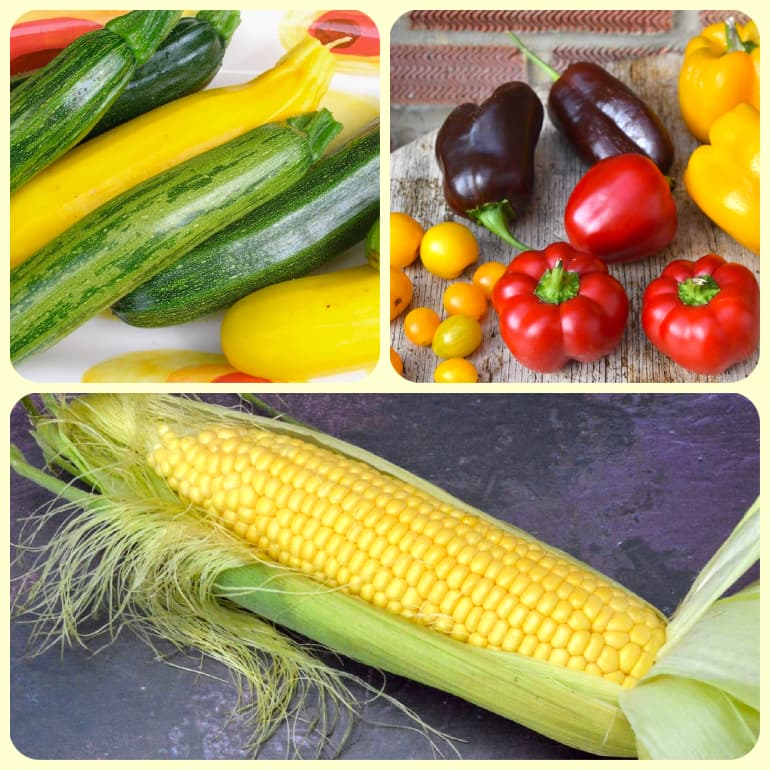
Although the fruit and veg mentioned here are widely available in the months of August, September or October, seasons vary quite considerably. So take this post as an approximate guide. I’ve picked the main fruit and veg you’re likely to come across, either in the shops or in your own garden.
August, September And October Vegetables
- Aubergines (Eggplants)
- Courgettes (Zucchini)
- Cucumbers
- Green Beans (String Beans)
- Mushrooms
- Peppers
- Sweetcorn
- Tomatoes
- Other Vegetables
August, September And October Fruit
Why Eat Seasonally?
Seasonal produce is harvested at peak ripeness, which means it’s fresher, tastier and often more nutritious than fruit and veg that have either been kept in cold storage or been imported from around the world.
Its carbon footprint is also a lot less. There’s a reduction in long-distance transport as well as out-of-season farming methods. In theory it’s cheaper to buy too as the sheer abundance leads to lower prices, both in markets and supermarkets. Buying seasonal produce also helps to support local economies.
Fresh seasonal fruit and veg are not only delicious, but highly nutritious too. They’re packed with fibre, vitamins, minerals and antioxidants. Eating a wide variety of them can help to keep us fit. They’re all crucial to a healthy gut and go a long way to reach our 5-a-day or even 10-a-day target as well as our thirty-plants-a-week.
If you grow your own, you’ll know that nothing tastes better than something freshly picked. We don’t all have the time or space to grow our own fruit and veg, but we can buy what’s in season.
Vegetables To Eat In August, September And October
Late summer and early autumn veg are such a joy to eat and cook. With all that summer sunshine baked into them, they taste amazing and they’re usually strikingly colourful. But what I enjoy the most, is that they’re really easy to prepare. Nothing to scrub or peel, just a quick rinse and chop and you’re done.
Aubergines (Eggplants)
Aubergines are often referred to as “poor man’s meat” because of their fleshy texture. This makes them an excellent vehicle for vegetarian and vegan main dishes. They do, however, work in all sorts of side dishes too.

I’ve never grown aubergines before, but I know plenty of people that do. They’re fairly easy to grow in the UK if you have a greenhouse, polytunnel or even conservatory. You should be able to harvest them through August, September and October.
How To Cook Aubergines
Aubergines are really easy to prepare and cook. If roasting or baking whole, you don’t need to do anything at all other than a quick rinse. Otherwise, just remove the top before slicing or chopping.
For dips and spreads, such as baba ganoush, you’ll need to remove the skins. But that’s easy too. Just bake or roast the whole aubergine, then cut in half and scoop out the soft flesh.
A word of warning though: don’t eat them raw, they need to be cooked to soften them and remove any bitterness. Fry them, grill them, bake them, roast them or add to tagines, stews and curries. They take on a slight smoky note when grilled or roasted, which lends itself well to certain dishes.
What Goes With Aubergines?
Aubergines are used widely across the Mediterranean and are particularly popular in Middle Eastern and Indian cuisines. They’re quite rich and almost creamy when cooked, but don’t have a great deal of flavour. This makes them ideal vehicles for soaking up other flavours.
Rich tomato sauces are ideal, but they’ll take any number of spices too.
Olive oil is a must when frying, roasting or grilling. Aubergine’s spongy nature takes on the flavour of the oil wonderfully. It’s best to use a good extra virgin olive oil though.
Other than olive oil and tomatoes, they pair well with garlic, cumin, coriander, cinnamon, smoked paprika, miso, olives, capers, sesame seeds, chickpeas and mozzarella.
Aubergine Recipes
There are many well known aubergine recipes like Italian parmigiana or caponata, Greek moussaka, Turkish imam bayildi, Indian baingan bharta and Japanese Nasu Dengaku. Here are three of my favourites:
- Baba ganoush (vegan) – Middle Eastern roasted aubergine and tahini dip or spread
- Barley bowl with spiced aubergine, chickpeas and tomatoes (vegan)
- Roasted Mediterranean vegetables (vegan)
Courgettes (Zucchini)
Courgettes are one of the easiest veg to grow in your own garden or allotment. They’re also prolific producers and my go to for late summer / early autumn veg. Although they start to crop in July, in a good year they will carry on producing throughout August, September and into October. The more you pick, the more they fruit.
Yes, courgettes are often long and green, but they come in all sorts of colours and sizes. Think striped, round, yellow and white. You can even find them shaped a bit like a trombone. They’re called tromboncino. Harvest courgettes and other summer squashes small and young for the very best flavour and texture. They’re mostly seedless at this stage.
How To Cook Courgettes
Courgettes are one of the blessed veg that are super easy to prepare and cook. All you need to do is take a thin slice off the top and bottom. They’re very tender, so easy to cut and there’s no need to peel them at all.
Simply slice and fry in a good quality olive oil and they’re really delicious. You can fry them until they’re just tender so they retain their inherent sweetness. Or fry at a higher temperature for a bit longer to caramelise them.
You can sauté them, roast them, stew them or turn them into soup. They also make a surprisingly good chutney. And of course, they work well in cakes, muffins and savoury bakes.
What Goes With Courgettes?
Courgettes go well with all sorts of other summer veg. Just think of a classic ratatouille with courgettes, peppers, onions, aubergines and tomatoes.
However, they also pair really nicely with cumin, garlic, lemon, ricotta cheese, eggs and yoghurt.
Courgette Recipes
I have lots of courgette recipes here on Tin and Thyme. They’re one of my favourite veg to use at this time of year. I also have a post on all the courgette recipes you will ever need. It’s well worth a look as it has lots of idea from a range of excellent cooks.
But, meanwhile, here are three of my favourite recipes:
- Chocolate courgette cupcakes (vegan)
- Courgette couscous: a quick & easy meal (vegan)
- Courgettes with yoghurt & za’atar
Cucumbers
Cucumbers are cooling, refreshing and help to keep us hydrated. Just like tomatoes, they’re actually a fruit rather than a vegetable. They’re quite versatile and are not only good in salads, but also sandwiches, smoothies and pickles.
Although you can buy British cucumbers pretty much throughout the year these days, they’re at their best in August. If you want to grow your own, it’s unlikely you’ll be able to harvest them much earlier than this. However, it’s fairly easy to raise cucumbers outdoors in the UK, so don’t worry if you don’t have a greenhouse or polytunnel.
How To Prepare Cucumbers
Thankfully, there’s generally not a lot of cooking involved with cucumbers. You can cook them, but for the most part they’re delicious eaten raw. Just slice or chop and you’re done. There’s no need to peel them.
Sometimes you need to grate cucumbers, remove the seeds or drain them of excess moisture. All of these processes are easy to do. Removing the seeds takes some of the wetness away and is a good idea if you’re using in pickles or a chopped salad.
They’re quick to grate on the large side of a box grater, or you can pass them through a food processor. To remove the seeds, simply half the cucumber, then run a teaspoon down the middle of each half and scrape out the seeds as you go.
To remove excess moisture once chopped or grated, mix with a pinch of salt, then leave in a sieve to drain. Place the sieve over a bowl so you can catch the juice. It makes a refreshing drink.
What Goes With Cucumbers?
Mint, dill, garlic, spring onions (scallions), butter, yoghurt, cream cheese, feta cheese and Marmite all pair well with cucumbers. They also work well with traditional salad ingredients such as lettuce, radishes, tomatoes and spring onions (scallions).
Cucumber Recipes
Although cucumbers are excellent in salads, there are many other ways to use them. I have several cucumber recipes, but here are three of my favourites:
- Cucumber & celery summer soup
- Cucumber roll-ups
- Tzatziki (Greek yoghurt sauce with cucumber, garlic and mint)
Green Beans (String Beans)
Fresh green beans are one of those vegetables that are actually quite hard to buy. I refuse to buy runner beans any more, because they always seem to be tough and stringy rather than young and tender.
Thank goodness for French beans, which generally fare better. Don’t be limited to these two types of green bean though, there are many different varieties and some of them aren’t even green. Red, yellow and purple are all good, though if you don’t grow your own you’ll probably only find those in farmers’ markets.
Green beans such as runner beans and French beans really come into their own in August and September. If you want to harvest the dried beans though, you’ll probably have to wait until October and just hope we get a dry month.
How To Cook Green Beans
Beans just need the tops nipped off them. I was taught to take the tails off as well, but you absolutely don’t need to and it reduces the amount of prep time quite considerably.
The easiest way to do this is to line a few beans up in a row, then take the tops off with a sharp knife all in one go.
I like freshly boiled or steamed green beans best. It’s easier to tell when they’re cooked if you do them this way. They should be tender, but still hold their shape and have a bit of a bite to them. Soggy or mushy green beans are horrid.
Even if adding to stir-fries, stews etc, it’s best to blanch the beans first for two to three minutes. This ensures they’re properly cooked through.
It’s best not to eat green beans in their raw state. Raw beans contain lectins which are bad for our guts. Furthermore, cooking them increases the bioavailability of various beneficial compounds. (Ref: Healthline)
How To Freeze Green Beans
In order to freeze green beans, you will need to blanch them first. If you don’t, the beans are likely to be rubbery or mushy and dull in colour. Blanch them for a couple of minutes in boiling water, then drain and allow to cool and dry.
Once cool, place on an open tray in a single layer and freeze for a couple of hours. Once frozen transfer to bags or freezer-proof containers. Remove as many as needed and cook from frozen.
What Goes With Green Beans?
Green beans are used a lot in Asian cuisines and can thus take lots of punchy flavours.
Other ingredients they pair well with include: almonds, basil, parsley, tarragon, garlic, carrots, tomatoes, tamari, Parmesan type cheeses and crème fraîche.
Green Bean Recipes
You’ll find several green bean recipes here on Tin and Thyme. Here are three of my favourites:
- Cypriot vegetable stew (vegan)
- Pesto green beans
- Spicy peanut butter noodles with steamed green beans and carrots (vegan)
Mushrooms
Although different mushrooms grow at different times of the year, October is the season for mushroom hunting. Many mushrooms are poisonous, so don’t pick or eat anything unless you’re completely sure that they’re safe to eat.
CT is pretty hot on identification, but I only know field mushrooms and puffballs and wouldn’t be confident trying anything else.
Luckily if you don’t know your mushrooms or can’t find any, you don’t need to feel left out. You can buy wild mushrooms at this time of year at farmer’s markets and even some supermarkets.
How To Cook Mushrooms
Compared to the veg that start cropping in August and September, mushrooms are a little trickier to prepare. Ideally, try not to get them wet as they absorb moisture very readily. It’s best to brush any dirt or grit off them with a soft brush.
Once cleaned, however, you can go right ahead and cut them as needed.
Mushrooms generally benefit from flash frying at a medium- high heat. First slice your mushrooms. Heat a good sized frying pan, add a little olive oil, then lay the mushrooms in a single layer, making sure not to overcrowd the pan. They’ll start to release their juices at first, but will then go on to caramelise in a most delicious way.
I have seen recipes which include raw mushrooms, but personally, I prefer not to eat them raw. Cooking will help to deactivate any harmful pathogens that might be lurking. This is especially true if they’re wild harvested. In any case, they’re much nicer cooked.
What Goes Well With Mushrooms?
Mushrooms have a wonderful earthy umami flavour all on their own. However, they also act a bit like sponges and can soak up all sorts of other flavours.
Mushrooms work really well with both rice and pasta, usually in a creamy type sauce. In much the same way they’re brilliant on toast. Eggs are another perfect partner. Mushroom omelette anyone? And don’t forget they’re an important part of a British fried breakfast.
Other ingredients that pair well with mushrooms are: garlic, thyme, sherry, pastry, walnuts, butter beans and cream.
Mushroom Recipes
I love mushrooms so you’ll find plenty of mushroom recipes on Tin and Thyme. Here are three of my favourites:
Peppers
We’re mostly used to cooking with bell peppers here in the UK, but Romano peppers are becoming increasingly popular. Mini peppers are super cute and often come in a range of colours. If you grow your own there are various varieties and a range of colours, including chocolate.
And don’t forget chilli peppers. They too are ready to harvest at the same sort of time as sweet peppers. Although you can grow some varieties outside, you’ll get a more reliable crop of sweet peppers and chillies if you grow them in a greenhouse, polytunnel or conservatory.
Look for local UK grown peppers at farmer’s markets and local greengrocers in August, September and October.
How To Cook Peppers
Although not quite as easy to prepare as courgettes, peppers are still quick and easy to cook with. You need to take out the seeds and core them. Then it’s just a case of leaving whole, halving, slicing or chopping.
They’re great vehicles for stuffing. You can do this in one of two ways.
- Remove the tops, take out the seeds, stuff, replace the tops and bake. They work well both dry or cooked in a sauce.
- Cut in halve, so you effectively have two bowls. Remove the seeds then fill the two halves. Bake as they are or in a sauce.
Peppers are delicious eaten raw. They’re ideal for chopped salads and make perfect dippers. Just cut into long thinnish slices and dip away.
How To Freeze Peppers
Peppers are very easy to freeze and use once frozen. Just slice them into thin batons, or chunks if you prefer, then place on an open tray in a single layer and freeze for a couple of hours. No need to blanch them first.
Once frozen, place in bags or containers. You can then remove as many slices as you like when you need them and cook from frozen.
What Goes Well With Peppers?
Much like courgettes, peppers go with other easy summer veg like aubergines, courgettes, tomatoes and onions. Just think French ratatouille.
Other ingredients they pair well with are: oregano, tarragon, chillies, olives, aubergine, sweetcorn, celery, eggs and vinegar.
Pepper Recipes
You’ll find a few pepper recipes here on Tin and Thyme. Here are three of my favourites:
- Easy paneer jalfrezi (curried peppers and onions with curd cheese)
- Smoky sweetcorn pepper fritters (vegan)
- Squash & red pepper soup (vegan)
Sweetcorn
Corn on the cob is the jewel in the crown of summer veg. It’s so bright, sweet and tasty, it puts a smile on everyone’s faces. Those boring green leaves may not look very interesting, but just peel them off and remove the silk strands and you have a thing of beauty.
Sweetcorn is usually ready to harvest throughout August and September. You know when the cobs are ready to pick because the tassels at the end go brown.
If you don’t grown your own, find them at farmer’s markets and even supermarkets these days.
How To Cook Sweetcorn
Sweetcorn is another of those summer vegetables that are easy to prepare. Not quite as much as some, but still pretty fast. Simply tear off the leaves and remove the silk strands. This is called shucking in the USA.
Fresh corn is delicious, just lightly boiled whole and smothered in butter. Make some chilli and lime butter and you’re in for a taste sensation.
Once you’ve had your fill of munching corn cobs, you can shave the kernels off the cob with a sharp knife and use them in a myriad recipes. You can lightly boil the cob first, roast it, grill it or remove the kernels raw and then cook them.
What Goes With Sweetcorn?
As mentioned above sweetcorn and butter are a perfect match. Just ensure you use salted butter rather than unsalted. The salty element complements the sweetness of the corn and brings out the flavour.
Other ingredients that pair particularly well with sweetcorn are: coriander, chilli, lime, black beans, feta cheese and mayonnaise.
Sweetcorn Recipes
I have a few sweetcorn recipes here on Tin and Thyme. Here are three of my favourites:
Tomatoes
Tomatoes really are the heavyweights of late summer and early autumn veg. Without tomatoes, much of our cooking would be an awful lot blander. Though technically a fruit, we treat them as a vegetable when it comes to cooking and eating. They’re full of sweet, sour and umami flavours and super easy to prepare, either raw in salads or in cooking.
The tomato harvest here in the UK mostly starts in August and goes right through September and sometimes into October. It all depends on when you sow them, where you plant them and what the weather is like that year.
If you don’t grow your own, these months are still the best in which to buy them. They really do taste so much better.
How To Use Tomatoes
How your prepare tomatoes very much depends on the type and size of the tomato you’re using. Large beefsteak type tomatoes are best simply sliced, though I like to remove the hard bit around the stem first.
These large tomatoes are best for cooking into sauces. I often find one large tomato is enough to make a good pasta sauce for the two of us.
When it comes to medium sized salad tomatoes, either slice or dice.
For many salads and salsas, cherry tomatoes are perfect. They’re so easy to prepare, you don’t need to do anything other than cut them. Keep them whole, halve or quarter them.
Mini tomatoes are also delicious roasted and make a good finish to all sorts of dishes. Coat them in a little olive oil first, scatter with herbs, salt and maybe some chilli. Garlic is always a good bet too.
How To Preserve Tomatoes
The easiest way to preserve tomatoes is to make tomato sauce and can it or freeze it. I have an easy recipe for tomato sauce and it really helps to enliven winter months.
You can also dehydrate them and if you’re lucky, sun-dry them. I’ve never tried, but I do have a dehydrator, so should perhaps give it a go.
What Goes With Tomatoes?
The question should probably be, what doesn’t go with tomatoes? I can’t think of many savoury ingredients that clash.
However, there are some ingredients that pair particularly well with tomatoes. Here are some of them: basil, chives, marjoram, oregano, thyme, garlic, chillies, olive oil, eggs and pretty much any type of cheese.
Tomato Recipes
I cook with tomatoes a lot during August, September and October whilst they’re still fresh and delicious. So it’s no surprise that I have plenty of both vegetarian and vegan tomato recipes on Tin and Thyme. Here are three of my favourites.
Other Vegetables In Season In August, September And October
August, September and October are the most abundant months for produce in the UK. There’s a whole heap of vegetables available. Harvest starts for much of the root veg, but I will be covering these in my next What To Eat post for the months of November, December and January.
Crops that come into their own in the early summer such as lettuce are also still available.
Other vegetables that are bang on season during these months include: artichokes, broccoli, celery, chard, kale, onions and potatoes.
Fruit To Eat In August, September And October
August, September and October are the most abundant months for produce here in the UK. There is so much to choose from it can get overwhelming. I’ve picked the main fruits you’re likely to come across, either in the shops or in your own garden.
Apples
September and October are the months for apples. Where I live you can’t walk from one end of the street to the other without coming across a box of apples someone has kindly left for passers by. Some years are more productive than others, but you won’t find apples that taste better than during these two months.
How To Prepare Apples
The easiest way to eat an apple is to tuck right in. But you do need to make sure it’s a dessert apple and not a cooking one. Cooking apples, such as Bramleys are incredibly tart.
However, sometimes you need to prepare dessert apples for a recipe. They make a fabulous addition to many salads and slaws. Quarter the apples, there’s no need to peel them, then remove the pips and cores with a sharp knife. Slice or dice the apples as needed.
Unless you’re eating the apples immediately, it’s best to coat them with a little lemon juice. This prevents the exposed flesh from oxidising and going brown. Once sliced, drop into a bowl and drizzle enough lemon juice over the slices to coat them. You don’t need much.
Cooking apples are perfect for pies, cakes and other bakes. They break down quickly whilst cooking, so you don’t need to pre-cook them before using.
Just like dessert apples, you need to remove the pips and cores. For larger apples I cut them into eighths to do this. Whether you peel them will depend on the recipe you’re making. I’ve found over the years, that unless the skins are tough, there’s no need to peel for many recipes that state you do.
Try and cover the apples with other ingredients as soon as possible to prevent oxidisation. Otherwise, coat in lemon juice first.
What Goes Well With Apples?
Apples are similar to tomatoes in that they go well with lots of other ingredients. When it comes to dessert apples, cheese is the very first one that springs to mind. They pair well with pretty much any type of cheese, but especially blues.
For cooking, they pair particularly well with: cinnamon, cloves, blackberries, pears, oranges, hazelnuts, walnuts, brandy, caramel and veggie or vegan sausages.
Apple Recipes
Apples, especially crab apples and windfalls are loaded with pectin. This makes them an ideal addition to all sorts of low pectin fruit in jams and jellies. They’re essential for my hedgerow jelly for example.
Next to tomatoes, apple recipes probably feature most on Tin and Thyme. They’re so very versatile. Here are three of my favourites:
- Apple sauce – keeps well in the fridge for months
- Apple thyme cake – I have lots of delicious apple cakes, so it’s hard to make a choice
- Spiced apple chutney – I make at least one batch of this each year, usually two or three. It’s delicious.
Blackberries
It’s such a joy when blackberries first start to appear in our hedgerows in August. They continue right through to September, so there’s usually plenty of foraging opportunities.
As well as wild blackberries, there are plenty of cultivated varieties too. Many of these are thornless, which makes picking a lot less painful. However careful I am, I always get scratched and usually end up with stained fingers and clothes. It’s worth it though.
How To Cook Blackberries
Although blackberries are good to eat raw, they make good fillings for pies, crumbles, cobblers and similar puddings. The good news is that you don’t really have to do much in the way of preparation.
It’s a good idea to throw them in a bowl of clean water so that any duds or debris can float to the surface. Pour off any such debris, then drain the blackberries in a sieve or colander before using.
How To Freeze Blackberries
Once rinsed, lay the blackberries on a tray in a single layer and freeze for a couple of hours. As soon as they’re frozen, transfer to a bag or freezer-proof container and freeze for up to six months.
What Do Blackberries Go With?
Blackberries and apples pair so well that probably the most ubiquitous pudding at the end of august and beginning of September is blackberry and apple crumble. Both fruit ripen at a similar time and blackberries provide colour and flavour to cooked apples, which can sometimes be a bit bland.
Likewise, hazelnuts start to appear in the hedgerows at about the same time as blackberries and they too work particularly well. This hazelnut meringue with blackberries is just gorgeous. But then so are these blackberry tarts with a hazelnut pastry crust.
Other ingredients that pair well with blackberries are: cinnamon, ginger, nutmeg, star anise, mint, raspberries, chocolate, mascarpone, berry liqueurs and port.
Blackberry Recipes
As I go out foraging for blackberries every year, I have quite a few blackberry recipes on Tin and Thyme. Here are three of my favourites:
- Blackberry barfi – a British take on an Indian sweet
- Blackberry ice cream – an easy no churn version
- Blackberry overnight oats – a healthy and easy start to the day
Figs
We’re lucky enough to have a fig tree growing in our garden. We learned fairly early on that blackbirds are very fond of figs, so we now net individual ones. Not all of them, but enough so that we get to enjoy a few. This year I made fig jam from our own figs for the very first time.
How To Cook Figs
Fresh ripe figs are delicious eaten just as they are and make an excellent dessert in their own right. When it comes to cooking, roasting is the way to go.
They’re terribly easy to prepare, simply slice them, halve them or keep them whole.
What Goes With Figs?
Figs are good in both sweet and savoury dishes. If roasting for either, a drizzle of honey really helps.
Other ingredients that pair well with figs are: cinnamon, thyme, rocket, walnuts, goat’s cheese, halloumi, clotted cream and balsamic vinegar.
Fig Recipes
I don’t have as many fig recipes on Tin and Thyme as I probably should. But here are three of my favourites:
- Easy fig chutney with pomegranate molasses
- Fig & goat’s cheese tart with honey and walnuts
- Fig tarts with white chocolate and mascarpone filling
Hazelnuts
Hazelnuts, I’m happy to say, grow really well in Britain. They have a lovely sweet, buttery flavour, but are decidedly crunchy. You’ll find them growing wild in the countryside with plenty of cultivated varieties in town parks and gardens. They’re also farmed, particularly in the county of Kent.
Hazelnuts are in season throughout August, September and October. However, in August, you’ll only find green hazelnuts, which haven’t fully ripened, but are delicious in their own way.
How To Prepare Hazelnuts
It can be a bit of a faff to prepare fresh hazelnuts. The kernels are covered in hard shells which you need to crack. And this can take a considerable amount of time if you need a lot of hazelnuts. But they do taste much better than the ones you can buy ready shelled.
Once you have the hazelnuts, you need to remove their skins. Roast them in the oven for ten minutes or dry fry them. This process not only gives them a lovely flavour, but it loosens the skins. You can then easily rub the skins off using a clean tea towel, paper towel or even your hands.
Depending on what you’re making you may want to keep the hazelnuts whole, chop them with a sharp knife or grind them up in a food processor.
What Goes With Hazelnuts?
Hazelnuts are delicious eaten both raw and roasted. And they work equally well in savoury and sweet recipes.
As ripe hazelnuts are ready to harvest at more or less the same time as apples and blackberries, they go very well with both of these fruits.
Chocolate is a classic pairing as any lover of Nutella will tell you. Other chocolate and hazelnut spreads are available. It’s actually surprisingly easy to make your own. If you want to give it a try, just swap the cashews for hazelnuts in my recipe for chocolate cashew nut spread.
Other ingredients that pair well with hazelnuts are: vanilla, coffee, dried apricots, brown butter and brie.
Hazelnut Recipes
As hazelnuts are a seasonal UK nut, I feel duty bound to create hazelnut recipes on a regular basis. Luckily, I really like them. Here are three of my favourites:
- Hazelnut shortbread
- Roasted hazelnut brownies
- Roasted squash with sage and hazelnuts in brown butter
Pears
British pears come into their own in September, though some won’t be ready to pick until October. If growing your own, pick them whilst they still feel firm, as pears are deceptive and ripen from the inside out. They’re ready when they come away in your hand relatively easily.
How To Prepare Pears
Ideally pears should be firm, but sweet and tender at the same time. If they’re hard, they’re not ripe. To ripen pears quickly, place them in a brown paper bag with a ripe banana. The banana gives off ethylene which speeds up the ripening process.
Eat raw pears whole or cut into quarters and remove the stem and core. There’s no need to peel the skin, which is tender and a good source of fibre.
For cooking, you may need to peel them. It very much depends on the type of recipe you’re making. Peeled or not peeled, it’s still a good idea to remove the stem and core. Unless, that is, a recipe states otherwise.
What Do Pears Go With?
When anyone asks me “what was your all time favourite meal?” I have to say it was sitting on the side of a quiet road in France, with my bike by my side and feasting on a sweet juicy pear with a slab of French cheese and a packet of Le Petit Beurre biscuits.
The combination is lovely, but I suspect it had more to do with the general ambiance than anything else.
However, pears and cheese make for an excellent combination. Throw some good bread into the mix and you have a simple but delicious lunch. I find pears go particularly well with blue cheeses, aged cheddars, goat’s cheese and ripe brie.
Other good combinations include:
- Salad Greens such as rocket (arugula), radicchio, endives, frisée, dandelion leaves and watercress. Their bitter base notes balance out the sweetness of the pears and provide a good textural contrast.
- Hazelnuts add crunch and contrast to the sweet softness of pears.
Other ingredients that go well with pears are: cardamom, coriander, ginger, vanilla, rosemary, chocolate, red wine and dessert wine.
Pear Recipes
There aren’t nearly as many pear recipes as there are apple ones on Tin and Thyne, but there probably should be. Pears are quite versatile and are just as good in salads or on a cheese board as they are in cakes and puddings. Here are three of my favourites:
Plums
The plum family is quite a big one. It includes gages, mirabelles, damsons, bullaces and sloes. They vary from super sweet, to sour to bitter. As well as in taste, they differ in colour too. They range from green to golden, to red to purple to almost black. Not all types of plum will be suitable for all recipes.
Plums are usually ready to harvest in August and September, depending on the variety and the weather.
How To Prepare Plums
Plums aren’t always the easiest fruit to prepare. For most recipes you’ll need to remove the stones inside the fruit. To do this rinse the fruit first, then cut the plums in half with a sharp knife. If you’re lucky you’ll have a freestone variety where the stones almost fall out, but for clingstone varieties you need to prise them out with a knife.
Some recipes such as sloe gin or damson gin, you just use the whole fruit, which is a mighty relief I can tell you. Both of these are clingstone varieties.
Thankfully, you don’t need to remove the skins. Once you’ve taken the stones out, go for it. There are lots of ways you can cook plums. Slice or chop as needed.
What Do Plums Go With?
Plums are particularly good in sweet recipes. Stew or roast them to go with your morning porridge or overnight oats, bake them into tarts and cakes, dry them into prunes or make this easy plum jam. Much like apples, plums also make a very nice chutney.
Ingredients that pair well with plums include the following: allspice, black pepper, cinnamon, nutmeg, almonds, oranges, rose, yoghurt, pastry, amaretti and amaretto.
Plum Recipes
For more inspiration, take a look at my plum recipes. Meanwhile, here are three of my favourites:
Quince
There are two types of quince, true quince (Cydonia oblonga) which comes from a deciduous tree and Japanese quince (Chaenomeles japonica) which is a thorny bush. Both are edible, though you need to cook them. They’re really rather unpleasant raw.
The best way to get hold of quinces is to grow your own or know someone who does. You’re unlikely to find any in the supermarket, but you might get lucky in a farmer’s market or local greengrocer.
Quince are ready to harvest in late October. You know they’re ripe as they turn a golden yellow and start to smell fragrant. Quince has the most sublime perfume. It’s worth keeping one in a room just to scent it.
If you end up picking them too early, don’t worry, they will ripen indoors and generally keep well for a few weeks.
How To Prepare Quince?
Quince are quite tough, so be careful when cutting with a knife. Use a large sturdy one and put some force into it. They’re pretty similar to pears when it comes to preparation, but they do need cooking.
Poaching quince is the easiest way to cook them. It takes quite a while though. Cut the fruit into quarters. You can either remove the core immediately, or poach them first and remove the core when they’re tender.
What Goes With Quince?
As well as Manchego, quince also complements Comté, Beaufort and Gouda. It also pairs well with cinnamon, cloves, vanilla, apples, pears, lemons, Greek yoghurt and cream.
Quince Recipes
Membrillo is probably the best known quince recipe. It’s a Spanish sweet paste which pairs perfectly with cheese, especially the afore mentioned Manchego.
The following are the only two recipes for quince I have on Tin and Thyme. It seems like I need to up my game in the quince department.
Raspberries
Although you might get the odd autumn raspberry in August, they really come into their own in September. They may well go on into October too. I find autumn raspberries a lot easier to grow than summer ones and they usually taste amazing.
How To Prepare Raspberries
Much like blackberries, you don’t need to do anything to raspberries, other than give them a quick rinse.
Either eat them just as they are for dessert with a little cream maybe. Or add them to your morning granola or all sorts of desserts. Alternatively eat them straight off the plant, as I do, they seem to taste better this way.
Raspberries are excellent in various cakes and bakes too. They provide a shot of tartness that contrasts well with all that fat and sugar. Add them to your bake just as they are, but go carefully when trying to mix them in so that they don’t break up too much.
How To Freeze Raspberries
Once rinsed, lay the raspberries on a tray in a single layer and freeze for a couple of hours. As soon as they’re frozen, transfer to a bag or freezer-proof container and freeze for up to six months.
What Do Raspberries Go With?
Raspberries are such a flavoursome berry, they add a boost to all sorts of recipes.
They pair particularly well with; mint, blackberries, strawberries, chocolate, cream, yoghurt, honey, framboise, oats, cake, pastry and pancakes.
Raspberry Recipes
I have a lot of raspberry recipes on Tin and Thyme, especially when it comes to baking. Here are three of my favourites:
Other Fruit In Season In August, September And October
There are plenty of other fruits to eat in August, September and October. Stone fruit such as apricots, cherries and peaches are still in season, but as they start earlier in the summer, I shall include them in my Fruit To Eat in May, June And July post.
Other fruit that starts to ripen during late summer and early autumn are: ground cherries, medlars, mulberries and elderberries.
Keep in Touch
Thank you for visiting Tin and Thyme. If you cook with seasonal fruit and veg in August, September and October, I’d love to hear about it in the comments below. Do you have any recommendations or tips for cooking with late summer and early autumn fruit and vegetables?
For more delicious and nutritious recipes follow me on Twitter, Facebook, Instagram, Flipboard or Pinterest. And don’t forget to SUBSCRIBE to my weekly newsletter. Or why not join the conversation in our Healthy Vegetarian Whole Food Recipes Facebook Group?
If you’d like more late summer recipes or early autumn recipes, follow the link and you’ll find I have quite a lot of them. All delicious and nutritious, of course.
Choclette x
What To Eat In August, September And October. PIN IT.