
Healthy Treacle Scones
These healthy treacle scones are really easy to make, naturally sweetened with molasses and full of warming gingerbread flavours. They’re perfect for autumn and winter baking, afternoon tea or as a comforting homemade snack. Enjoy these deliciously tender bakes warm, with salted butter, for a nourishing treat.
In my quest for foods that are helpful in regulating blood pressure, I recently read that mineral-rich molasses has a part to play. I’ve cooked with blackstrap molasses for more years than I care to remember, but I don’t use it very often. Time to change that.
Dive Right In
- Why You’ll Want To Make These Treacle Scones
- What Makes These Treacle Scones Healthy?
- How To Make Healthy Treacle Scones
- Other Recipes With Molasses You Might Like
- Keep In Touch
- Pin It
- The Recipe
Why You’ll Want To Make These Treacle Scones
As well as a quick and easy bake to help you through the colder months of the year, there are any number of reasons to make this treacle scone recipe. Here are a few of them.
- Great for afternoon tea, lunchboxes or a nourishing snack with a mug of something hot.
- A healthy riff on the classic Scottish recipe, keeping the spirit but lightening the load.
- The perfect bake to celebrate Bonfire Night.
- Smell wonderful as they bake, like warm spices drifting through the house.
- Surprisingly simple to make, even on a busy day.
- Tender, comforting and lightly sweet, with a hint of gingerbread that feels like autumn in snack form.
- Uses everyday ingredients, yet feels like a wholesome upgrade on classic scones.
What Makes These Treacle Scones Healthy?
Well, it’s actually very easy to turn traditional scones into a healthy snack whilst keeping them super tasty. As you can see from the image below the ingredients are few and wholesome. The only possible controversial one is butter. And as my butter is organic and thus mostly grass fed, in these quantities it’s actually not bad at all.

Molasses
For these “treacle scones”, I actually use blackstrap molasses instead of treacle. Treacle is a refined product with added invert sugar syrup, whereas blackstrap molasses is a pure byproduct of the initial raw sugar refining process. It’s considerably healthier as it’s chock full of minerals and is especially rich in iron, magnesium and potassium. (ref: Dr Axe)
It’s still high in sugar though, so is best consumed in moderation. About half to one tablespoon a day is considered efficacious for adults. That’s somewhere between ten and twenty grams. For children, however, the general recommendation is just one teaspoon.
Blackstrap molasses has a very distinctive taste and always reminds me of good gingerbread and my mum’s treacle pudding. There is a bitter undercurrent though, so it might take a bit of getting used to.
You can use molasses or treacle pretty much interchangeably. Molasses has a slightly stronger flavour and is less sweet, but it’s also a lot healthier.
I also omit the sugar that everyone seems to add to their scones along with the treacle. Scones don’t need to be super sweet and the molasses gives a gentle caramel depth, which is quite sweet enough.
The Rest
As with all my scones, I use wholemeal spelt flour instead of refined white flour. Wholemeal flour contains plenty of dietary fibre as well as various vitamins and minerals. Spelt flour is generally easier to digest than modern wheat varieties and is thus better for gut health.
I also use a mix of bicarbonate of soda and cream of tartar rather than baking powder or self-raising flour. It seems to give a better rise and doesn’t contain any fillers. You can easily swap them for baking powder if you prefer.
And finally, instead of milk, I use kefir. That’s mostly because we make our own and often have a surplus. Whilst the baking process kills the live probiotics present in raw kefir, other important nutrients remain. It also reacts with the bicarb and cream of tartar and helps the scones to rise.
If you don’t have kefir, try buttermilk, sour milk or watered down yoghurt instead. They’re all good options.
Although it won’t have the same properties as true sour milk, you can make your own cheat’s version. Here’s how:
Stir a teaspoon of lemon juice or apple cider vinegar into milk and let it sit for two to three minutes. It will curdle, which is what you want. As with true sour milk, kefir or buttermilk, it then reacts with the raising agents to help lift the scones.
How To Make Healthy Treacle Scones
Scones are one of the easiest and quickest bakes to make. However to get light and tender scones, there are a couple of techniques worth noting.
Please refer to the recipe card at the bottom of this post for cooking temperatures and quantities of ingredients used.
Step 1. Prep
Get prepped before you start. Once you begin making the scones, it’s best to proceed as fast as possible as once the dry ingredients hit the wet ones, the chemical reaction starts and you really want them in the oven when this happens.
Pour your chosen liquid into a measuring jug and lightly grease a baking tray. Grab scales, a large mixing bowl, sieve, measuring spoons and a sturdy round bladed knife.
Preheat the oven, or do as I do and start with a cold oven. It works just as well and eliminates the time and energy needed to heat up the oven first.
Step 2. Make Dough
In a large mixing bowl, measure in the flour, raising agents, spice and salt. You can substitute baking powder for the cream of tartar and bicarbonate of soda if you wish. See the note on this in the recipe card.
Add the butter and cut it into small pieces with a knife. Rub the flour into the butter with your fingertips until the mixture resembles breadcrumbs.
Make a well in the centre and pour in the kefir followed by the molasses. Using the knife, stir from the inside out until a rough dough forms. If the mix is too dry add a little more kefir, but go carefully. You want a soft dough, but not a sticky one.
Gather the dough together with your hands and knead it very briefly so that it’s more or less smooth.
Top Tip
You want to handle the scone dough as little as possible. Stir or knead it too much and you may end up with tough scones rather than tender ones. It’s for this reason I use a knife to stir everything together. I also don’t use a rolling pin for the same reason.
Step 3. Stamp Out Scones
Using your hands, pat the dough into an even round on a lightly floured surface. You could use a rolling pin for this, but you absolutely don’t need to. Use a round cutter or glass to press as many scones out as you can. Flour the cutter in between each press so that the dough doesn’t stick to it.
Gather the offcuts together and repeat the process until you’ve used up all the dough. I made eight scones with mine. For the last bit, I tend to just roll it into a ball with my hands and flatten it slightly.
Place the scones well apart on the baking tray. Brush the tops with a little kefir, if liked. It’s not essential, but it gives the scones a slightly less rough and ready appearance.
Step 4. Bake Treacle Scones
Bake in the centre of the oven until the scones are well risen and firm to the touch, but not too brown. If you’re not sure if they’re properly baked, tap one on the bottom. If it sounds hollow, it’s done.
However, it’s better to err on the side of caution as overcooked dry scones aren’t nearly as nice as tender ones.
Step 5. Serve
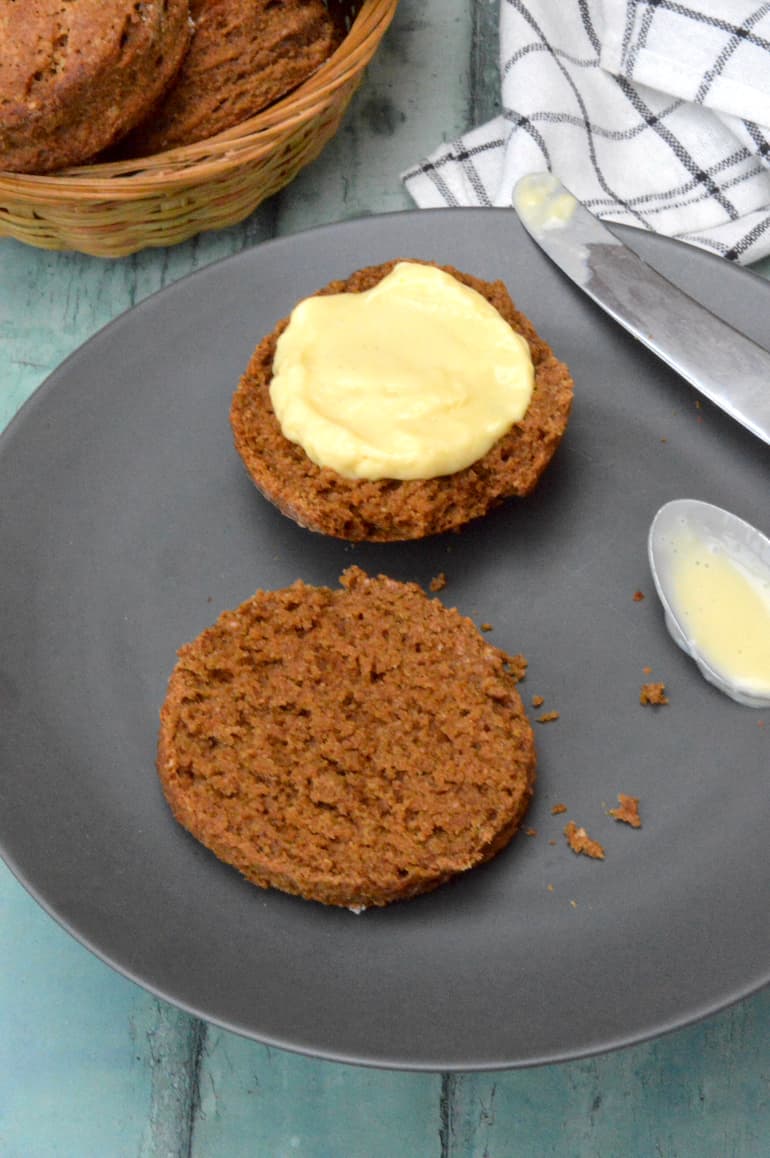
Transfer the scones to a wire rack to cool, or eat them straight away whilst still warm. Split them in two and slather with salted butter. I also like them spread with homemade lemon curd.
They’re at their best on the day of baking, but are still good to go on day two. If you like you can warm them in a warm oven (150℃, 130℃ fan, 300℉, Gas 2) or air fryer (130℃, 250℉) for five minutes. But they don’t actually need it.
For longer term storage, you can freeze scones for up to a month. Let them cool thoroughly, then place them in a freezer-proof container or bag. When ready to eat, leave them to thaw in their container at room temperature for a couple of hours.
Other Recipes With Molasses You Might Like
- Latvian rye sourdough bread
- No-knead spelt bread
- Prune gingerbread loaf cake
- Pulled jackfruit in homemade barbecue sauce
- Vegan gingerbread chocolate truffles
Keep in Touch
Thank you for visiting Tin and Thyme. If you make these healthy treacle scones, I’d love to hear about it in the comments below. Do you have any recommendations or tips for using molasses?
Please rate the recipe too. And do tag me @choclette8 on Instagram with your images, I love to see your take on my recipes.
For more delicious and nutritious recipes follow me on Twitter, Facebook, Instagram, Flipboard or Pinterest. And don’t forget to SUBSCRIBE to my weekly newsletter. Or why not join the conversation in our Healthy Vegetarian Whole Food Recipes Facebook Group?
If you’d like more scone recipes, follow the link and you’ll find I have quite a lot of them. All delicious and nutritious, of course.
Choclette x
Healthy Treacle Scones. PIN IT.
Healthy Treacle Scones
Ingredients
- 225 g wholemeal spelt flour
- 1 tsp bicarbonate of soda
- 2 tsp cream of tartar
- 1 ½ tsp mixed spice or pumpkin spice
- 1 pinch fine sea or rock salt
- 60 unsalted butter fridge cold
- 120 ml kefir, buttermilk, sour milk or watered down yoghurt + extra for brushing
- 2 ½ tbsp blackstrap molasses organic blackstrap is best
Instructions
- Preheat the oven to 220℃ (200℃ fan, 425℉, Gas 7), or do as I do and bake in a cold oven. It works just as well and eliminates the time and energy needed to heat up the oven first.
- In a large mixing bowl, measure in the flour, raising agents, spice and salt.225 g wholemeal spelt flour, 1 tsp bicarbonate of soda, 2 tsp cream of tartar, 1 ½ tsp mixed spice, 1 pinch fine sea or rock salt
- Cut the butter into the flour mix so that you haven't got one big lump, then rub in with your fingertips until the mixture resembles breadcrumbs.60 unsalted butter
- Make a well in the centre and pour in your chosen liquid followed by the molasses. Using a round bladed knife, stir from the inside out until a dough forms. If the mix is too dry add a little more kefir, but go carefully. You want a soft dough, but not a sticky one.120 ml kefir, buttermilk, sour milk or watered down yoghurt, 2 ½ tbsp blackstrap molasses
- Gather the dough together with your hands and knead it very briefly so that it’s more or less smooth.
- Press it into a round on a lightly floured surface. It should be somewhere between ¾ and 1 inch in height. Use a 6cm (2 ½ inch) cutter cutter to press as many scones out as you can. Eight is ideal. Gather the offcuts together and repeat the process until you have no dough left.
- Place the rounds on a lightly greased baking tray. Brush the tops with a little kefir, if liked.
- Bake for 12 to 15 minutes or until the scones are well risen, firm to the touch and the bases sound hollow when tapped. It's better to err on the side of caution as dry scones aren't nearly as nice as tender ones.
- Transfer to a wire rack to cool, or eat straight away whilst still warm. Delicious with salted butter, and also lemon curd we've found.
Baking these this morning to surprise Stew with at the allotment at lunch. Even went out specially to buy spelt flour first. Just love your first direction – relieved me of guilt of not doing things right! If you do it, it’s fine…..!
Hope they worked for you Alison and more importantly, that Stew appreciated them. I’m just making flatbreads with spelt right now.
These look really lovely! I’ll give them a go. Here in Canada we can buy either blackstrap or fancy molasses. I wonder if the fancy kind is the same as the treacle type you mention? It’s definitely less dark and less strong tasting.
Apparently there are three types of molasses – a light one after the first boil, a darker one after the second and then blackstrap after the third. And that’s the one you want. Our treacle actually has some sort of syrup added to it – I don’t think molasses does. Though I could very well be wrong about that. Do give us your verdict when you make the scones.
These scones sound lovely. I like ‘gingerbready’ flavours and with the WM Spelt flour I would enjoy these a lot. I usually bake my bread from a cold start but never thought of doing it with scones….. so I will try it!
Thanks Choclette :))
Gingerbready things are a firm favourite with us too, especially at this time of year. I’ve been trying more and more bakes from a cold start. I was a bit trepidatious the first time I tried scones, but they work really well so that’s how I bake them these days.
Looks like a yummy reciepe. Do you think it would veganize ok w/ non-dairy substitutes for the butter and soured milk? thanks.
Hi Jacquie. Yes indeed, you could use coconut oil, evoo or some other healthy fat instead of butter and plant milk is fine – you can sour that with lemon juice or cider vinegar too – soy is best. I have two vegan scone recipes, both slightly different, but both work well. This one uses olive oil – https://tinandthyme.uk/2021/10/healthy-pumpkin-scones/ and this one coconut oil – https://tinandthyme.uk/2020/08/vegan-wholemeal-scones/