
Medlar Tart: A Delicious Autumn Dessert
Medlars are an old fashioned fruit that are hard to find in the shops. But if you have a tree in your garden or know someone who does, this medlar tart recipe is a must bake. Once you’ve pulped the fruit, it’s a cinch to make and it’s super delicious too.
This post may contain affiliate links. As an Amazon Associate, I earn from qualifying purchases. See my cookie and privacy statement for further details.
Last week, I came back from a trip home to Cornwall with a bag of medlars and a box of cooking apples. I have very generous friends. The apples I’ve mostly turned into apple purée, but what to do with the medlars?
Dive Right In
- Why You’ll Want To Make This Medlar Tart
- What Are Medlars?
- How To Prepare Medlars
- Autumnal Medlar Tart
- Ingredients, Additions And Substitutions
- How To Make Medlar Tart
- Other Fruit Tart Recipes You Might Like
- Keep In Touch
- Pin It
- The Recipe
Why You’ll Want To Make This Medlar Tart
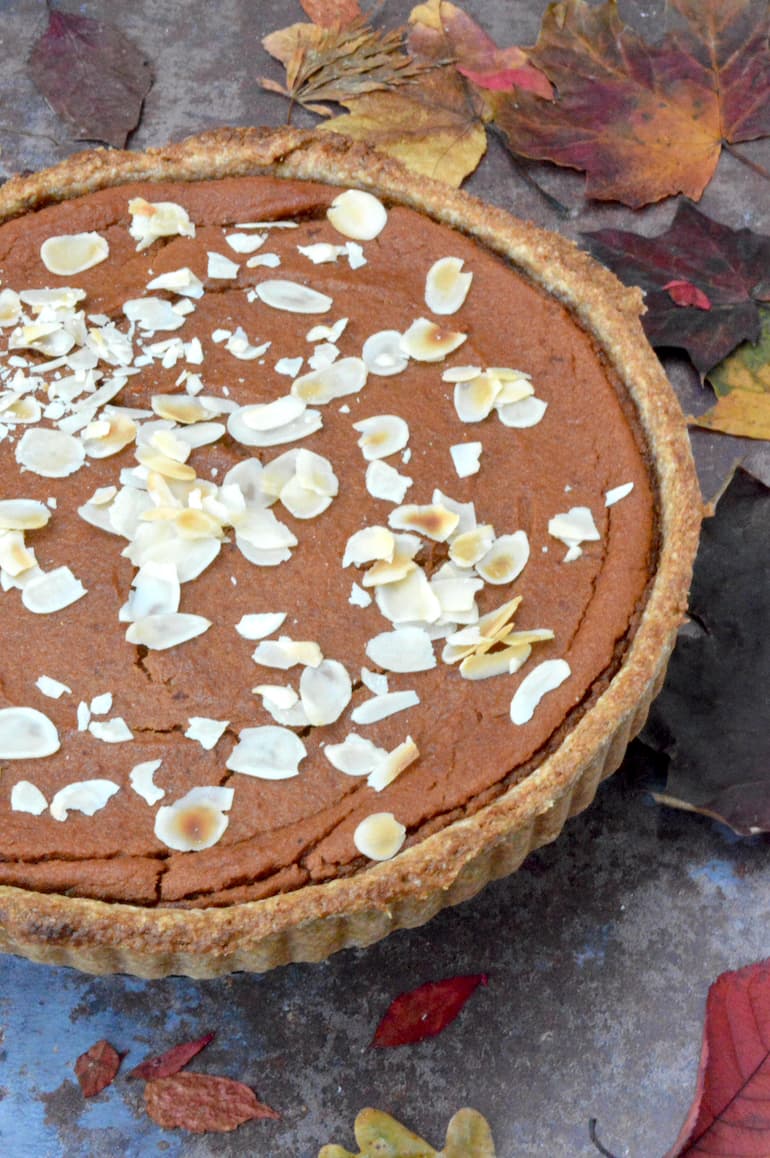
This autumnal medlar tart (medlar pie) combines spiced wholemeal pastry with a creamy, custard-like medlar filling lifted with clementine. It’s a lovely way to enjoy this old-fashioned fruit, with deep caramel notes, gentle sweetness and a flavour that’s far more delicious than its humble appearance suggests.
- A true taste of autumn – Medlars have a naturally spiced, apple-meets-date flavour that feels instantly autumnal. It’s a great alternative to the usual seasonal bakes.
- Creamy, gently spiced filling – Medlar pulp combined with muscovado sugar, cream, egg and clementine creates a custardy texture with both sharp and deep caramel notes.
- Not too sweet – Wholemeal flour, fruit pulp and muscovado give richness without cloying sweetness, so the tart feels balanced and grown-up.
- Nutty wholemeal pastry – The whole wheat crust is subtly sweet, warmly spiced and lifted with clementine zest and juice, making it flavoursome before you’ve even added the filling.
- Showcases an unusual, heritage fruit – Perfect for anyone who enjoys trying something a bit different or wants to make the most of local, foraged or home-grown produce.
What Are Medlars?
It’s sad but true, most people haven’t heard of medlars (Mespilus germanica). They are indeed a mostly forgotten autumn fruit. This is a real shame as they are quite delicious. They’re in the Rosaceae family so are related to both apples and roses. In France they are not so elegantly known as cul de chien. You may see why if you look at the picture below.

The fruit is of a medium size and is brown skinned. It looks a bit like a cross between an apple and a rosehip. Each one contains a few hard seeds, sometimes called “pips” and sometimes “stones”.
In the UK medlars are generally ready to eat in November. The best time to pick them is after a hard frost. You then need to leave them in a cool place to blet. When picked the fruit are hard and bitter, but leave them to go completely soft and the fruit’s starch turns to sugar and the bitterness disappears. This process is called bletting.
If you’re unfamiliar with medlars, you may think they’ve gone rotten, but no. Once bletted, they have a sweet slightly toffeeish taste with a hint of citrus. You can eat them both cooked and raw.
As with all members of the Rosaceae family, medlars have a high vitamin C content, so are particularly useful at this time of year. They’re also good for dietary fibre and antioxidants.
Although I’ve made medlar jelly on many an occasion, the only other medlar recipe I have on Tin and Thyme is maamoul: Middle Eastern stuffed cookies. If you’d like to make medlar jelly, you can use my recipe for quince jelly. It has a much softer set though.
How To Prepare Medlars
Medlars are a bit fiddly to prepare. They can take quite a while to peel and then extracting the pips isn’t all that easy either. The following method is the easiest way to turn medlars into a purée which you can then use to make this tart or something else.
Place bletted medlars into a heatproof bowl then cover them with boiling water. Leave them to soak for two to three minutes, then drain. This process loosens the skins, which then makes them easier to work with.
Working with two or three at a time, place them in a large gauge stainless steel sieve or colander and place a clean bowl underneath. Using a ladle or large metal spoon, press the fruit through to extract as much of the flesh as you can.
From nearly a kilo of fruit, I made 550 grams of purée using this method plus a good few spoonfuls of “medlar butter” for porridge and toast.
So as to avoid waste, place the bits left behind in the sieve into a saucepan. Do this as you go along so that the skin doesn’t clog up the sieve.
When you’ve pressed all of the fruit, cover the discarded bits with water. Bring to the boil, then simmer for five to ten minutes. Pass this through the sieve using the same method as before. It will produce a thick liquid which you can simmer down with a little sugar and spice if you like. The resulting medlar butter makes an ideal topping for porridge.
You can then discard the skins and anything else remaining in the sieve. We put it into our compost bin.
Autumnal Medlar Tart
Medlar jelly is delicious, but I already have a few jars of quince jelly in the cupboard, so when I was gifted nearly a kilo of medlars, I wanted to do something a bit different.
Medlar tart works brilliantly as a dessert. It may look a little rustic, but it more than makes up for its looks in flavour. It’s a tart to wow your dinner party guests or just to brighten up your day.
Serve it warm or at room temperature. Both ways are good. It’s quite rich and creamy, so it doesn’t really need any accompaniment. But if you fancy a little additional cream or crème fraîche on the side, go ahead.
Kept in a cool place, it will last for several days, though the pastry and almonds won’t stay crisp. Despite this, we enjoyed it just as much on day five as we did on day one.
We both reckon this medlar tart is way more delicious than similar autumnal pies such as pumpkin pie or pecan pie. You’ll have to try it and see if you agree.
Ingredients, Additions and Substitutions
Apart from the medlars, the ingredients for this tart are quite simple. It’s really just an enhanced wholemeal pastry case with a creamy fruit filling.
Citrus
Clementines are ideal as they have a sweet orangey flavour, but also a decent element of sharpness to them. This is needed to lift the tart’s rich caramel tones which might otherwise be a bit cloying. They’re also nice and juicy.
You can substitute two halves of an orange for the two clementines, but try to go for a tangy orange if you can.
Flour
I use wholemeal spelt flour, which is my favourite flour for baking cakes, biscuits and pastries. Follow the link to find out why. Ordinary wholemeal (whole wheat) flour is absolutely fine to use though.
If you’re gluten intolerant, use a good gluten-free flour and a teaspoon of xanthan gum instead of the wholemeal flour.
Spices
Any sweet spices work well with medlars. I’ve used pumpkin spice, but mixed spice or allspice are both good. Alternatively, use a mix of any of the following: ground cinnamon, ground ginger, ground nutmeg and ground cloves. Just go easy on the cloves as they have a powerful taste.
Sugar
Light brown sugar is the way to go with this tart. It complements the medlar’s inherent caramel notes, without taking over. I use muscovado sugar as it’s less processed than ordinary brown sugar and has a more intense flavour.
How To Make Medlar Tart
Turning the medlars into a purée is a bit of a faff. But once you’ve done that it’s all plain sailing.
Please refer to the recipe card at the bottom of this post for cooking temperatures and quantities of ingredients used.
Step 1. Make Pastry
The pastry needs a bit of time to rest, so it’s best to make this first.
Place the flour, sugar, salt and spice into a large mixing bowl. Add the cubed butter and rub it into the dry ingredients with your fingertips until the mix resembles breadcrumbs.
Make a well in the middle and break the egg into it. Add the clementine juice and zest and a tablespoon of water. Work the wet ingredients into the dry with a sturdy knife until the mix starts coming together to form a dough. You may need to add more water as you go, but be careful not to make it sticky.
Gather everything together with your hands and form the dough into a ball. Pat it into a disc, wrap it so that it doesn’t dry out and leave it in a cool place to rest for twenty minutes or so.
Step 2. Prepare Filling
Whilst the pastry is resting, purée the medlars, if you haven’t already. See the section on how to prepare medlar purée. Then make the filling.
In a medium sized bowl beat the sugar and spice into the medlar pulp until any lumps have mostly disappeared.
Next beat in the egg, followed by the cream. Lastly beat in the clementine zest and juice. By this time you should have a nice smooth purée.
Top Tip
Use any leftover pastry to make cinnamon swirls.
Step 3. Line and Fill Tart Tin
On a floured board, roll the pastry into a round big enough to cover your tart tin.
Drape the pastry over your rolling pin, then transfer it to fill the tin. Press the pastry down then up and into the sides. Trim the edge with a knife.
Scrape the filling into the pastry case and level it out with the back of a spoon so that it fills the case as evenly as possible.
Top Tip
If you use a tin rather than a ceramic dish or silicone mould, you shouldn’t need to pre-bake your pastry case. I never do and I rarely have a “soggy bottom”.
Step 4. Bake
Place the tart onto the middle shelf of a hot oven and bake for twenty five minutes, by which time it should be well risen.
Working quickly, remove the tart from the oven and scatter the almonds over the top. Return the tart to the oven and bake for a further ten to fifteen minutes. It’s done when it no longer wobbles when you shake it.
Leave to cool for ten to fifteen minutes before removing from the tin. Transfer the tart to a plate and serve warm or at room temperature.
Other Fruit Tart Recipes You Might Like
- Apricot frangipane tart
- Blackberry tarts with a hazelnut pastry crust
- Double apple tarts
- Persimmon tarts
- Plum galette
- Quince tart
Keep in Touch
Thank you for visiting Tin and Thyme. If you make this autumnal medlar tart, I’d love to hear about it in the comments below. Do you have any recommendations or tips for dealing with medlars?
Please rate the recipe too. And do tag me @choclette8 on Instagram with your images, I love to see your take on my recipes.
For more delicious and nutritious recipes follow me on Twitter, Facebook, Instagram, Flipboard or Pinterest. And don’t forget to SUBSCRIBE to my weekly newsletter. Or why not join the conversation in our Healthy Vegetarian Whole Food Recipes Facebook Group?
If you’d like more pastry recipes, follow the link and you’ll find I have quite a lot of them. All delicious and nutritious, of course.
Choclette x
Medlar Tart. PIN IT.
Medlar Tart
Ingredients
Pastry
- 200 g wholemeal spelt flour
- 50 g golden caster sugar
- 1 pinch fine sea or rock salt
- ½ tsp pumpkin spice or mixed spice, or allspice
- 100 g unsalted butter fridge cold and cubed
- 1 egg
- 1 clementine or half an orange – zested and juiced
Filling
- 500 g medlar purée anywhere between 500g and 600g is fine (using around a kilo of fruit)
- 125 g light muscovado sugar or soft brown sugar
- 1 tsp pumpkin spice or mixed spice, or allspice
- 1 large egg
- 90 ml double cream (heavy cream)
- 1 clementine zested and juiced
- 10 g flaked almonds
Instructions
- Pastry
- Place the flour, sugar, salt and spice into a large mixing bowl. Add the cubed butter and rub it into the dry ingredients with your fingertips until the mix resembles breadcrumbs.200 g wholemeal spelt flour, 50 g golden caster sugar, 1 pinch fine sea or rock salt, ½ tsp pumpkin spice, 100 g unsalted butter
- Make a well in the middle and break the egg into it. Add the clementine juice and zest and a tbsp of water. Work the wet ingredients into the dry with a sturdy knife until the mix starts coming together to form a dough. You may need to add more water as you go, but be careful not to make it sticky.1 egg, 1 clementine
- Gather everything together with your hands and form the dough into a ball. Pat it into a disc, wrap it so that it doesn’t dry out and leave it in a cool place to rest for twenty minutes or so.
- On a floured board, roll the pastry into a round, 4mm (1/6 inch) thick.
- Loosely roll the pastry around the rolling pin, then unroll it over a 23cm (9inch) round tart tin. Press the pastry down and into the sides, then trim the edges.
Filling
- Whilst the pastry is resting, get on with mixing the filling.
- In a medium sized bowl beat the sugar and spice into the medlar pulp until any lumps have mostly disappeared.500 g medlar purée, 125 g light muscovado sugar, 1 tsp pumpkin spice
- Next beat in the egg, followed by the cream. Lastly beat in the clementine zest and juice. By this time you should have a nice smooth purée.1 large egg, 90 ml double cream (heavy cream), 1 clementine
- Set the oven to 180℃ (160℃ fan, 350℉, Gas 4).
- Scrape the filling into the pastry case and level it out so that it fills the case as evenly as possible.
- Place the tart onto the middle shelf of the hot oven and bake for twenty five minutes.
- Remove the tart from the oven, scatter the almonds over the top, then bake it for a further ten to fifteen minutes. You’re looking for a well risen tart that no longer wobbles when you shake it. As soon as it stops wobbling, it’s done.10 g flaked almonds
Notes
Nutrition Estimate
This post contains affiliate links which are marked with an asterisk* or (affiliate link). If you buy through a link, it won’t cost you any more, but I might get a small commission. Thank you for your support of the brands and organisations that help to keep Tin and Thyme blithe and blogging.
You are quite right. I’ve never seen a Medlar but I have heard of them. I would love to find some and have a play to see what I could come up with. I don’t think I’ll have much luck hunting down a tree but you never know. :))
Ooh, now there’s a project for you Mary. The trees are full of white blossom in the spring and have good autumn colour, so I’d be surprised if there aren’t a few about.
We loved this recipe! The Wholewheat pastry is crisp and tasty, not just a bland container for the filling. The medlar curd filling is a bit like spiced pumpkin or apple but not quite like anything I’ve tasted before. We have a medlar tree and this year it produced it’s first real crop so I’ve been experimenting. There is something quite nostalgic about this tart as though you’ve been transported back to a mediaeval feast!
Goodness Sue, you were quick off the mark. So pleased you like the tart. It makes a nice change from jelly, though I like that too. I haven’t tried making medlar cheese yet – have you? We’ve recently ordered an apple tree and I’m now rather wishing we’d gone for a medlar.
I haven’t made medlar cheese either, but have made a medlar preserve. We had about 10 kilos from the tree. Some is in the freezer, but I had some pulp waiting, planning on using a rather similar recipe from Doves Farm. Yours looked interesting so I went with that!
Ah, that explains how you were so quick off the mark. Ten kilos sounds good. I hope you manage to come up with some other interesting ways to use them.