
Oats: The Ten Types You Need To Know About
Oats come in many forms from sprouted, to whole, to rolled, to flour. And then there’s oatmeal. They’re all healthy and they all have their uses in recipes and food preparation. Some you can swap for other forms and some you can’t. Learn the difference between them and discover which type is best for cooking, baking and breakfast recipes.
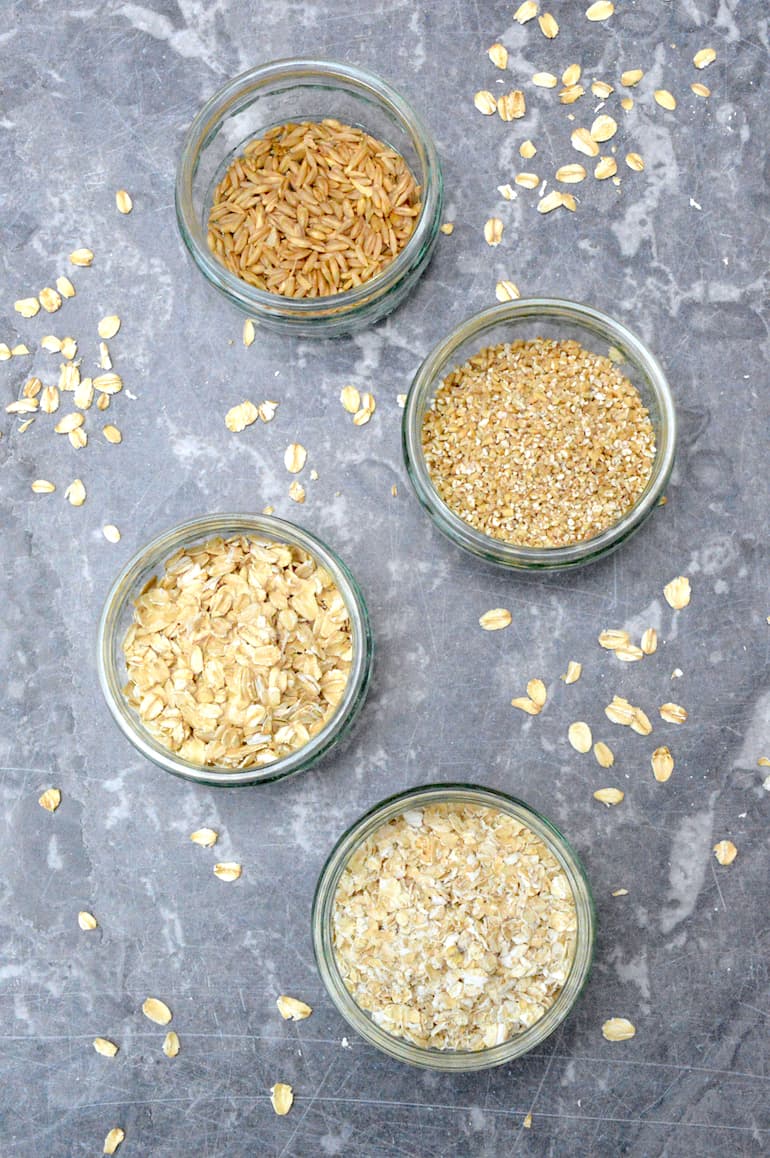
I love oats in all their forms and consequently eat quite a lot of them. Porridge is still my favourite breakfast and I’ll often have it as an impromptu pudding too. But there’s far more to this grain than my favourite breakfast cereal. I use it to add flavour and additional nutrition to all sorts of recipes.
What Are Oats?
Oats are a cereal crop produced by the grass plant Avena sativa. They’re a whole grain and one of the most nutrient dense foods you can eat. They’re packed with healthy fibre, protein, vitamins, minerals and antioxidants.

Gut health is all the rage at the moment and oats are a good source of soluble fibre, which helps to maintain a healthy gut. Because of their slow release of energy, they keep you feeling fuller for longer. They may also help to treat high cholesterol and keep blood sugars stable. (Ref: Healthline)
There’s more to oats than just porridge. Indeed they’re a versatile ingredient and can be used in lots of recipes that aren’t immediately obvious. They have the added benefit of being naturally gluten-free.
They’ve proved their worth over the years and have been a staple food source for many. We’ve been eating them for at least 32,000 years. (Ref: PNAS, 2015)
Types Of Oats
Oats come in all shapes and sizes. Each variety has its own texture and purpose, whether you’re making flapjacks, creamy porridge or adding extra fibre to your baking. Here’s a simple guide to the different types and what to use them for.
1. Whole Oat Groats
Whole oats are the mostly unprocessed raw oat kernels. They only have the outer husk removed and are thus in their most natural form. They contain the cereal germ, the fibre-rich bran part of the grain, as well as the endosperm.
- Processing – The whole grain is cleaned and only the outer tough hull is removed.
- Cooking – Groats require a long cooking time (about 45-60 minutes). It’s usually best to soak them overnight or for a few hours prior to cooking. This not only helps the grains to cook faster, but also makes them easier to digest.
- Uses – Whole oats are chewy with a nutty flavour. They’re best used as a substitute for rice or in grain salads and bowls.
All other forms come from these oat groats.
Naked Oats (Avena nuda)
As the name implies, naked oats are easily threshed out of the husks. This is not the case for conventional oats. The threshing leaves clean groats that you can use immediately.
They’re often grown by amateur gardeners and allotmenteers as they’re relatively easy to home process.
2. Oatmeal
In British terminology, oatmeal (sometimes referred to as Scottish oatmeal) generally refers to stoneground oats – not rolled ones. That means whole oat kernels that have been milled into a coarse meal. It comes in three different grades: fine, medium and coarse. Fine oatmeal looks a bit like wholemeal flour.
Oatmeal isn’t suitable for eating raw but is used to make the absolute best porridge as well as to add texture to cooked and baked dishes.
- Processing: Groats are stone-ground into a fine, medium or course meal.
- Cooking: Fine oatmeal cooks very quickly, but medium oatmeal is the best one for porridge. It takes about ten minutes to cook. Coarse oatmeal benefits from soaking and/or slow cooking overnight.
- Uses: Oatmeal has a nuttier flavour than rolled oats and quite a different texture. It’s ideal for making porridge with just water and salt. Fine oatmeal creates a creamy porridge, medium a slightly thicker, more rustic one and coarse is best for a hearty, textured bowl. Oatmeal is also an essential ingredient in oatcakes, haggis and cranachan.
- Recipes: chocolate porridge, vegan haggis, cranachan
The secret to an indulgent bowl of Scottish porridge is a spoonful of cream and a nip of whisky served on top.
3. Steel Cut Oats
In the US, coarse oatmeal is also known as pinhead oatmeal, Irish oats or steel-cut oats. It’s similar to coarse Scottish oatmeal except the groats are cut into two to three pieces using steel blades.
- Processing – Steel blades cut oat groats into two or three pinhead-sized pieces.
- Cooking – Takes an hour or so to cook and generally benefits from soaking overnight prior to cooking
- Uses – They have a nuttier flavour than rolled oats and are noticeably chewier. You can use them in much the same way as you would coarse oatmeal. The two are pretty much interchangeable. They’re particularly good for making stuffing.
4. Rolled Oats (Porridge Oats)
Rolled oats come in various forms, but the most common is porridge oats, known as quick oats in America. As the name suggests, these are useful for a quick and creamy porridge. Because they’re already quite soft, they also make excellent overnight oats.
Rolled oats are not called “oatmeal” in the UK. They are however, mostly used to make porridge, which Americans often refer to as “oatmeal.”
They’re generally the best type of oat to use in cookies and flapjacks. They also make a good binding agent for veggie burgers, patties and the like. Rolled oats are the ones I use the most in my kitchen.
- Processing: Groats are steamed, rolled very thinly, then broken into small flakes. This makes them one of the quickest oats to cook.
- Cooking: Cooks in three to five minutes.
- Uses: As rolled oats have already been partially cooked, it’s fine to eat them raw. They’re most often used for porridge, granola, bliss balls, smoothies, cookies, muffins and overnight oats.
- Recipes: blackberry overnight oats, chocolate coconut flapjacks, raw oat truffles, white bean burgers, carrot smoothie
5. Jumbo Oats (Old-Fashioned Oats)
As their name suggests, these are much bigger than standard porridge oats. They’re also coarser, chewier and take longer to cook, so are ideal for recipes where you want texture.
- Processing: Groats are steamed, then rolled flat to speed up cooking.
- Cooking: Cooks in about ten minutes.
- Uses: Mostly used for porridge, granola, muesli, cereal bars, biscuits and bread.
- Recipes: vegan honey and almond granola, apricot coconut energy balls, healthy energy bars, coffee and walnut protein balls
Jumbo oats aren’t my favourite for making porridge as I find them too coarse. But I always use them when making muesli and granola.
6. Instant Oats
Instant oats are another type of rolled oat. But these are the most processed of all the various oat types. They often have added sugar and flavourings, so are not the healthiest ones to eat.
- Processing: Steamed, rolled even thinner than porridge oats and broken into smaller flakes. They’re fully cooked before being dehydrated.
- Cooking: Requires only hot water or milk and cooks in under a minute.
- Uses: Often come as instant oat packets with added flavourings for cooking in a microwave or on the stove top. They’re good for quick breakfasts and often used as baby food. Brits: think Ready Brek.
7. Oat Flour
You can buy oat flour or make your own. It’s generally cheaper to make your own and very easy. Just blend rolled oats in a blender, food processor or coffee grinder until you have a fine flour.
- Processing: Ground (often from rolled oats) into a fine flour.
- Cooking: Used as a gluten-free alternative in baking.
- Uses: Pancakes, bread, muffins and thickening soups and sauces.
- Recipes: easy cottage cheese loaf
8. Oat Bran
Oat bran is not a whole grain, as other types of oats are. However, it’s particularly high in fibre and beta-glucan, so is often used to boost other recipes. It’s also lower in calories and carbohydrates than other forms of oats. And it’s a good source of iron and zinc.
- Processing: The outer layer of the oat groat is separated during milling and thus becomes oat bran.
- Cooking: Cooks quickly and can be eaten raw or cooked.
- Uses: Add to cereals, smoothies and baked goods such as bread, muffins and crackers for extra fibre.
9. Sprouted Oats
There are several benefits to sprouted oats, including making the vitamins, minerals and antioxidants present more bioavailable. They’re ideal if you’re looking for more nutrient-dense and easy-to-digest grains in your diet.
Starches break down during sprouting, which is why they’re easier to digest. The oats have a slightly nuttier and sweeter taste compared to their non-sprouted counterparts.
- Processing: Oat groats are soaked in water and allowed to germinate, initiating the sprouting process. Once sprouted, they’re dried and then rolled, turned into flour or left whole.
- Cooking: Similar to regular rolled or whole oats, sprouted oats cook in about five to ten minutes in their rolled form and much longer as groats.
- Uses: Ideal for porridge, overnight oats, granola, baking and smoothies.
- Recipes: overnight oats with apples and raisins
10. Gluten-Free Oats
All oats are inherently gluten-free. However, many of them are grown in fields alongside rye, wheat or barley which do contain gluten. They may also be processed in mills used for those same crops. This means the likelihood of cross contamination is high.
Look for packs labeled gluten-free oats. These are both grown and processed in isolation and should be safe for those with a gluten intolerance to consume.
Although oats don’t contain gluten, some people may still be sensitive to them. This is because there’s another protein present called avenin. It’s similar to gluten, but is better tolerated by most with coeliac disease and associated disorders. (Ref: Coeliac UK)
Keep in Touch
Thank you for visiting Tin and Thyme. If you’re a regular user of oats, I’d love to hear what you make with them in the comments below.
For more delicious and nutritious recipes follow me on Twitter, Facebook, Instagram, Flipboard or Pinterest. And don’t forget to SUBSCRIBE to my weekly newsletter. Or why not join the conversation in our Healthy Vegetarian Whole Food Recipes Facebook Group?
If you’d like more oat recipes or oatmeal recipes, follow the links and you’ll find I have quite a lot of them. All delicious and nutritious, of course.
Choclette x
Types of Oats. PIN IT.
I really enjoyed learning about the different types of oats, especially the differences between rolled, jumbo, and steel-cut oats. It’s a helpful guide for choosing the right oats for everyday meals and healthy recipes.
I’m glad you found it useful, with so many types of oats, it can get a bit confusing sometimes.
Thanks for all that useful information Choclette, so helpful. Will definitely be trying some of your oat recipes to test out my new found knowledge! In the meantime, I shall enjoy my breakfast porridge.
Ah, but the question is which type of oats do you use for your breakfast porridge?
Thank you Choclette, I had never realized there were so many variations of the humble oat !
Janet (The Netherlands)
Indeed, it’s quite surprising. As I really like the flavour though, I’m happy to have it in as many forms as possible.
Thank you Choclette, very interesting. Especially useful if following an ‘american recipe’. Like you I love oats, even using an ‘oat milk powder’ in my porridge, or on cereals. I use ‘rolled oat, oat bran and ground flaxseed’ in my porridge and my muesli mix, and often use rolled oats in my crumbles. As I have some cottage cheese in my fridge that needs using I shall now make your ‘cottage cheese loaf’.
Kind regards
Tessa
Ooh, I’ve not come across oat milk powder before. My brain has now gone into overdrive trying to figure out what exactly that is. Will look it up shortly. Oats are just brilliant, I use them in crumbles too. Hope you enjoy the cottage cheese loaf.
That was a good read thanks Choclette. I mostly use Jumbo Oats both for baking and my Granola which I look forward to every morning on my Blueberries and Yoghurt. I shall print this out and keep it handy. :))
Homemade granola with fruit and yoghurt is my go to breakfast for summer – it’s hard to beat. Interesting that you use jumbo oats for baking. What sort of baking?
Biscuits! :)) I sometimes give them a moment or two in the Processor to make them a bit finer. I love the Jumbo Oats in my Granola which is a bit of snack as well. Can’t keep my hand out of the jar if I’m a bit peckish. I use the Oats in Bliss Balls – mixed up with Dates and Cashews etc. No flour or sugar so a nice snack with coffee.
Have a look at a Baking book from down under and you’ll see recipes using oats. :))
Ah interesting Mary. I use porridge oats for all the recipes you describe – apart from granola. I find jummbo oats just a bit too harsh for things like bliss balls and biscuits. And I know exactly what you mean about granola making a good snack.