
Chayote Curry: A Simple Spiced Vegetable Side Dish
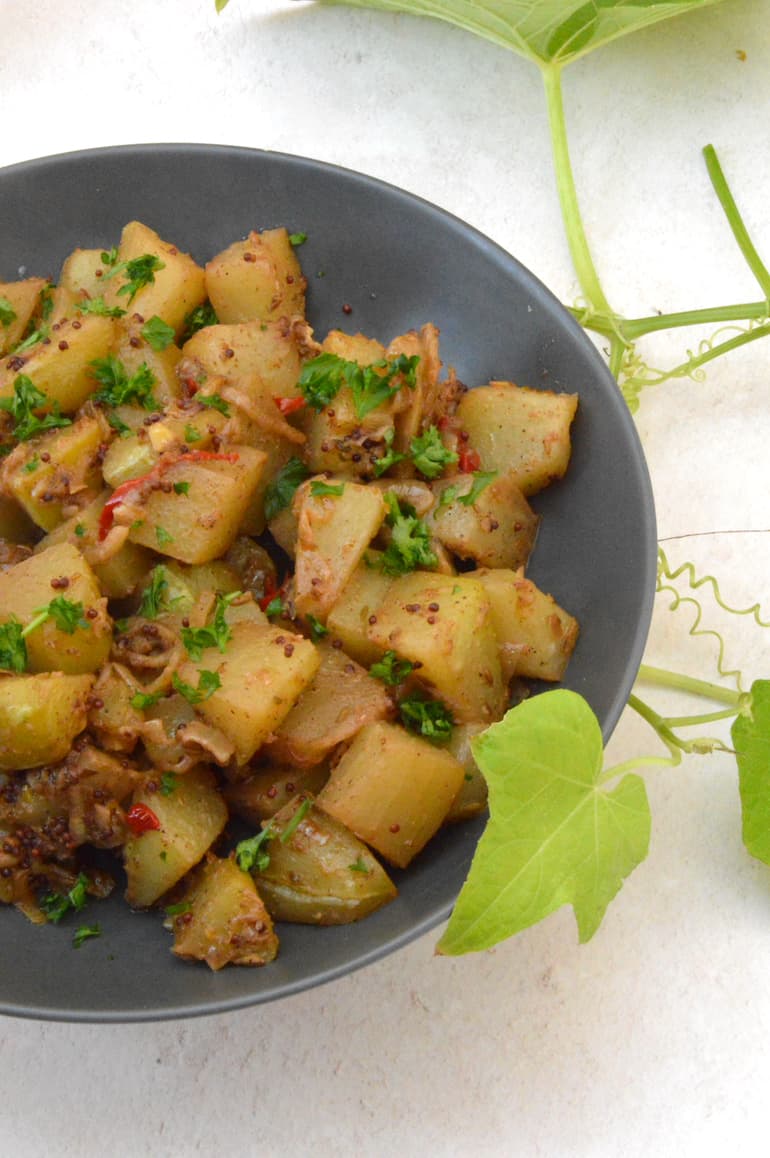
A light chayote curry recipe which makes a lovely vegetarian side dish. It’s a dry-style curry and gently spiced to allow the squash’s delicate flavour to shine. It goes well with all sorts of curries, but pairs particularly well with dhal, rice and a spoonful of chutney or yoghurt.
This post may contain affiliate links. As an Amazon Associate, I earn from qualifying purchases. See my cookie and privacy statement for further details.
Dive Right In
- What Is Chayote?
- Why You’ll Want To Make This Chayote Curry
- Ingredients, Additions And Substitutions
- How To Prepare Chayote
- How To Make Chayote Curry
- Other Spicy Sides You Might Like
- Keep In Touch
- Pin It
- The Recipe
What Is Chayote?
Chayote (Sicyos edulis), known variously as choko, chou chou and vegetable pear, is a squash type vegetable in the cucurbit family. Although we generally use it as a vegetable, it’s technically a fruit. It’s usually green with a pear shape, but is larger and sometimes covered in spines.

With a mild but fresh and slightly sweet flavour, pretty much all of the plant is edible. The most commonly eaten part is the flesh of the fruit, which is what we’re using in this chayote curry. But you can cook it in myriad ways. Just think courgette (zucchini). Fry it, roast it, add it to soups, stews and stir-fries or eat it raw in a salad.
As with most fruit and veg, chayote is highly nutritious. According to the latest medical research, it’s likely that it’s good for heart health, gut health and anti-aging as well as controlling blood sugar levels. It’s high in both soluble and insoluble fibre as well as various antioxidants, essential vitamins and minerals, including folate. In addition, it’s also low in both sodium and carbohydrates. (Ref: Healthline)
Pronounced (chai-o-tay), it started life in Central America. It was an important food source for the Mayans and Aztecs, but since the Spanish Conquest it has spread around the globe. Other common names include: mirliton, christophine and chow chow. I first came across it in Australia, where it’s commonly grown and is called choko.
In the UK, it can be a bit touch and go to grow, as the fruit generally aren’t ready for harvest before autumn. This means if there’s an early frost you won’t get a crop. It’s a tropical plant after all. However, CT has grown a really good crop these last two years. It’s a prolific producer.
For those who are interested in growing it here in the UK, it’s worth checking out the Chayote Adaptation Project facebook group.
Why You’ll Want To Make This Chayote Curry
If you’ve not cooked with chayote before, this simple curry is a lovely place to start. It’s lightly spiced to let the squash’s delicate flavour stand out and works really well alongside other Indian-style dishes.
- Curry Night – Delicious served as part of a thali-style meal or curry spread or simply with rice or chapati.
- Delicate Flavour – This is a dry curry rather than a saucy one, so the mild sweet taste of the chayote really comes through.
- Light Yet Satisfying – A simple dish yet full of flavour – perfect for balancing out a richer curry or creamy dhal.
- Perfect Side Dish – Works brilliantly as a side dish alongside all sorts of other curries, but it’s particularly good with lentils and other pulses.
- Nourishing – Naturally plant-based and full of goodness.
- Something New – A lovely way to try something a bit different. Chayote has a gentle flavour and a tender bite that takes well to spices.
Ingredients, Additions and Substitutions
For a curry, the ingredient list in this recipe is quite short. Apart from onion, garlic and a few spices, you only need the chayote.
Chayote
Unless you grow chayote yourself or know someone who does, it’s not that easy to get hold of here in the UK. Some larger supermarkets sell it as do Asian markets or you can buy online. It’s much easier to buy in America.
You could use a sweeter squash such as butternut as a direct replacement, but the flavour will be noticeably different.
Spices
If you want to actually taste the chayote, less is more when it comes to adding other ingredients. I’ve gone for fresh ginger, cumin seeds, mustard seeds and a little garam masala.
Chilli is an optional extra. You can use mild kashmiri chilli powder or something hotter like cayenne. Chilli flakes are another option. A fresh green chilli is ideal, but I only had a red one, so used that.
Other extras which work well are a squeeze of lemon juice and a sprinkling of finely chopped coriander leaves (cilantro). I used parsley as I didn’t have any coriander.
How To Prepare Chayote
Chayote flesh is covered in a thin green skin. It’s not difficult to remove, but it’s worth getting rid of as it’s a bit tough when cooked. There is a slight drawback, however, as it contains a sticky sap that can irritate hands and is hard to get rid of.
To avoid any irritation, you can wear gloves when peeling or peel the chayote in a bowl of water. Alternatively use my preferred method – see below.
The chayote also contains a central seed. It’s edible, but not used in many recipes, including this one. The seed is quite soft and is easy to remove.
I rub a small amount of cooking oil over my hands prior to peeling. This acts as a barrier to the sap and I can peel away to my heart’s content. You can either use a sharp knife or a vegetable peeler.
You can peel it on one of two ways:
- Cut a small slice off the bottom of the chayote so that it can stand upright, then slice the peel off downwards with a knife. Once peeled, cut in half and remove the central seed with a sharp knife.
- Slice the chayote in half, remove the seed, then peel with a vegetable peeler. I find it easiest to cut it into quarters to both remove the seed and peel it.
Once peeled and seed removed, you can slice, cut into chunks or grate.
How To Make Chayote Curry
Once you’ve peeled the chayotes, the rest of this recipe is a breeze.
Please refer to the recipe card at the bottom of this post for cooking temperatures and quantities of ingredients used.
Step 1. Prepare Chayote
Start by preparing the chayote as they’re slightly fiddly to peel. Peel the fruit (see previous section on how to do this), then halve or quarter them and remove the central seeds.
Cut the flesh into chunks measuring roughly two centimetres cubed (¾ inch). Set aside.
Step 2. Slice Onion
Peel the onion, then cut in half. Thinly slice each piece into half moons.
If using, thinly slice the chilli. You may want to remove the seeds and membranes first if your chilli is a hot one.
Step 3. Fry Chayote
Over a medium to high heat, warm the oil in a large lidded shallow pan, then add the seeds. Let them sizzle for thirty seconds or until the mustard seeds start to pop.
Immediately add the onion slices so that the seeds don’t burn. Stir briefly, then allow them to soften for a couple of minutes.
Finely grate or mince the garlic and ginger directly into the pan and stir. A microplane (affiliate link) is brilliant for this. Add the chilli slices and salt, then stir again.
Add the chayote chunks and fry them for ten minutes, stirring occasionally to ensure nothing sticks and all sides have been in contact with the pan.
Top Tip
Ideally you want enough room in your pan to fry the chayote chunks in a single layer. A shallow cast iron casserole dish (affiliate link) is ideal. Sadly, I wasn’t thinking this time and made mine in a standard sized frying pan. It worked fine, but took longer to cook.
Step 4. Braise Chayote Curry
Sprinkle the garam masala over the top and add the water, then clamp the lid on the pan. Turn the heat down to medium and cook covered for a further ten minutes.
The water should have pretty much disappeared by this stage. Test for doneness. If the texture is to your liking, remove from the heat and serve. If not, cook for a further five to ten minutes, adding a little more water to prevent sticking as necessary. The chayote should be firm but tender – a little like a cooked carrot.
Step 5. Serve Chayote Curry
Depending on what you’re serving the curry with, you might like to squeeze a little lemon juice over the top and / or scatter with finely chopped coriander leaves (cilantro).
Serve the chayote with a dhal or other curry made with pulses, brown basmati rice or flatbreads, chutney and/or yoghurt.
We ate this one with brown rice, my lentil curry recipe, chopped parsley and yoghurt. It was good.
Other Spicy Sides You Might Like
- bang bang cauliflower
- courgettes with yoghurt & za’atar
- Mexican potatoes
- roasted cauliflower with smoked paprika and cocoa
- sticky chilli broccoli
- stir-fried brussels sprouts
Keep in Touch
Thank you for visiting Tin and Thyme. If you make this chayote curry, I’d love to hear about it in the comments below. Do you have any recommendations or tips for cooking with this type of squash?
Please rate the recipe too. And do tag me @choclette8 on Instagram with your images, I love to see your take on my recipes.
For more delicious and nutritious recipes follow me on Twitter, Facebook, Instagram, Flipboard or Pinterest. And don’t forget to SUBSCRIBE to my weekly newsletter. Or why not join the conversation in our Healthy Vegetarian Whole Food Recipes Facebook Group?
If you’d like more curry recipes, follow the link and you’ll find I have quite a lot of them. All delicious and nutritious, of course.
Choclette x
Chayote Curry. PIN IT.
Chayote Curry
Equipment
- microplane (affiliate link) optional
Ingredients
- 2 chayote
- 1 ½ tbsp sunflower oil or other neutral oil
- 1 tsp cumin seeds
- 1 tsp black mustard seeds
- 1 onion halved and thinly sliced
- 2 clove garlic finely grated
- thumb size knob root ginger finely grated
- 1 chilli (optional), green or red, mild or hot – deseeded and thinly sliced
- ¼ tsp sea or rock salt
- ½ tsp garam masala
- 4 tbsp water
Instructions
- Start by preparing the chayote as they’re slightly fiddly to prepare. Peel the fruit (see notes in main post for how to do this), then half it and remove the central seed.2 chayote
- Cut the flesh into chunks measuring roughly 2 cm (¾ inch).
- Over a medium to high heat, warm the oil in a large lidded shallow pan.1 ½ tbsp sunflower oil
- Spoon in the seeds and let them sizzle for thirty seconds or until the mustard seeds start to pop.1 tsp cumin seeds, 1 tsp black mustard seeds
- Add the onion slices and stir briefly. Let them soften for a couple of minutes, then add the garlic, ginger, chilli and salt. Stir.1 onion, 2 clove garlic, thumb size knob root ginger, 1 chilli, ¼ tsp sea or rock salt
- Add the chayote chunks and fry them for ten minutes, stirring occasionally to ensure nothing sticks and all sides have been in contact with the pan.
- Sprinkle the garam masala over the top and add the water, then clamp the lid on the pan. Turn the heat down to medium and cook covered for a further ten minutes. Test for doneness. If the texture is to your liking, remove from the heat and serve. If not, cook for a further five to ten minutes, adding a little more water to prevent sticking as necessary. The chayote should be firm rather than mushy but tender – a little like a cooked carrot.½ tsp garam masala, 4 tbsp water
We loved this, Choclette. Chayote pairs with cumin especially well I think. I also really appreciated the way you put the ingredient quantities at the end of each instruction point. Makes it so much easier reading from my laptop in the kitchen – all recipe bloggers should follow your lead!
Yay, good to hear you made the recipe and enjoyed it. I’m really glad you mentioned the instruction / ingredient point as I never know if people find it useful or not. My older recipes don’t have it, but they’re slowly getting updated.
Hi Choclette, in NZ they are called choco too. They grow very easy in our climate and one plant produces for years. My friend has one and shares tons of them every year. I just used them for any spicy recipe so far as they are very mild to my taste and they work for everything. Not many recipes around here. I will definitely cook your recipe when they are ripe again. I also wasn’t aware of the nutritional value, extra points for that.
Arohanui
Sigi
Oh, to think they come back year after year in NZ. We have to plant them annually here, but it’s so worth doing as they give such a good crop. Thanks so much for your feedback Sigi.
This vegetable is well known to me as ‘Choko’ and my mum used to cook it when I was growing up. Nothing quite as exotic as your recipe but just plain steamed with butter and pepper – more like marrow. It was nice but not remarkable.
I’m sure that the above combination would have been more exciting.
Thanks Choclette :))
Oh gosh, I’d forgotten about marrow. My mother used to cook it all the time – boiled and then covered in white sauce I think. Choko is definitely not a remarkable taste or texture, but it is nice and surprisingly nourishing too. If you grow your own, it’s also very cheap – bonus!