Basbousa: An Egyptian Semolina Yoghurt Cake
Basbousa is an Egyptian classic. It’s a dense semolina yoghurt cake flavoured with brown butter and honey and doused with a sweet citrus and rose honey syrup. You’ll find it in every pastry shop in Egypt and it’s often served with cream. But it’s not very easy to find here in the UK, so here’s an easy and delicious recipe for you to make your own.
AD – this is a commissioned post. See my cookie and privacy statement for further details.
In my youth, when it was rare to know anyone who had travelled abroad, I was a lot more adventurous than I am now. At just eighteen I set off to work in a Swiss hotel in order to learn French, something I hadn’t managed to pick up at school. At various times I hitchhiked from home to France, to Spain and to Switzerland and when I had only just turned seventeen I went to stay with relatives of relatives in Egypt for a month.
Living Abroad
This was long before mobile technology had been invented. Phones were landline only and it was phenomenally expensive to phone overseas. In the first year I was away in Switzerland, I had one phone call with my mother and that was Christmas day.
In Egypt, it was nigh on impossible to phone home. When I went to live there a few years later, the only way of phoning home was to do it through an operator at the post office. It cost a fortune and you had to queue for hours.
Writing letters was the only real means of communication and what a slow process that could be. I’m sure my mother would have rested a lot easier in her bed if she had been able to contact me directly and vice versa.
Phone Home
Today things are very different. Life for migrants can be tough. Feelings of homesickness can sometimes be overwhelming and the ability to connect with friends and family can often be a lifesaver. Lebara are specifically set up to help migrants and to connect them to each other and to their friends and family back home.
Lebara Mobile offer a free SIM with low cost international calls, no contract and no hidden charges. To enable migrants to help each other, Lebara to Lebara calls are free. And you don’t have to be coming to or leaving from the UK either, Lebara operates globally. My experiences of living and working abroad would have been very different if I’d had something like this at my disposal.
Part of the founding ethics of Lebara is to give back to the communities that migrants come from. A proportion of the company’s profits go to the Lebara Foundation. This helps displaced communities around the world with housing, health and schooling. This has particular resonance at the moment with the devastating earthquake in Napal which has displaced so many people.
Egyptian Food
I loved Egypt and didn’t feel homesick as I was only there for a short time. But I desperately wanted to communicate the exciting discoveries I was making. Life in Egypt was a very different thing to life back home in Cornwall.
As for the food, it was a revelation and I fell in love with it immediately. It was here I had my first taste of hummus, falafel, ful medames, baba ganoush, shakshuka and so much more. Despina, the matriarch of the family I was staying with was probably the best cook I’ve ever come across. We had big sit down feasts of Middle Eastern cuisine every single day.

When it came to Egyptian pastries, I was in heaven: spiced nutty baklawa soaked in rose scented syrup, crumbly crunchy kunafa and the best nougat I’ve ever had anywhere. However, the one I got the most excited about was a plainer less well known cousin, basbousa. This is an Egyptian semolina yogurt cake which is made with brown butter and doused in rose and lemon syrup.
The reason I was so excited was that the pastry shop I particularly favoured served it with a rectangle of what looked and tasted remarkably like clotted cream. Cornish clotted cream in Egypt?
My Arabic was never good enough to find out exactly what it was, but that’s my bet and I do know something about clotted cream. I so wanted to exclaim to my mother the first time I discovered it, but that immediacy was not to be.
Basbousa: Egyptian Semolina Yoghurt Cake
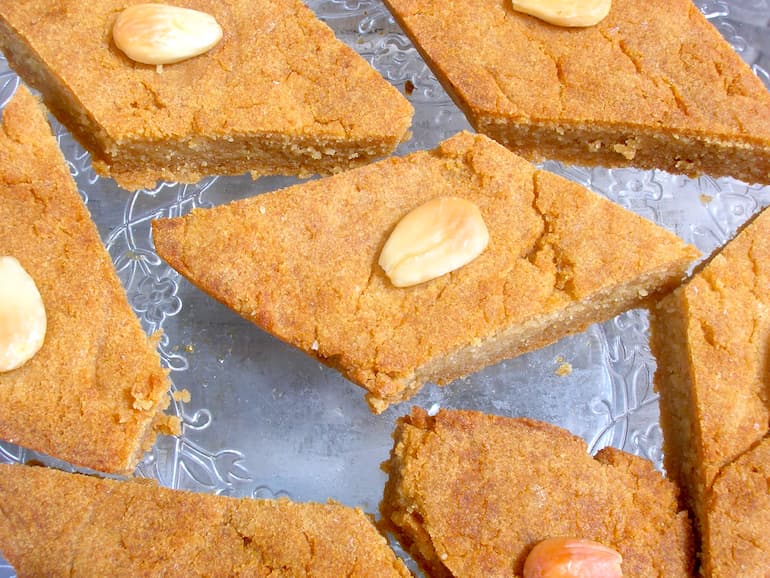
Traditional Egyptian basbousa is a fairly thin bake, with a soft but dense texture. Unusually it’s made without eggs and uses semolina instead of flour. Once baked, you soak it in sweet syrup.
I’ve tried on a number of occasions to recreate the wonder that was basbousa, but I never managed it – until now. This could of course be false memory syndrome and nostalgia getting in the way.
This recipe for basbousa is less sweet than those I used to eat. I just can’t bring myself to apply the copious amounts of sugar stated in all the recipes I looked at. It is, nonetheless, a rather delicious sweet treat. I used kefir rather than yogurt, but this is the closest to the cakes I remember from all those years ago. It has the same delightful dense consistency and squiggly top.
Notes of lemon, rose, honey, cardamom and cloves combine to make a flavour reminiscent of Egypt at its best. Of course I had to have a slice topped with a dollop of Cornish clotted cream – for old times sake.
Cut the basbousa into squares or diamonds. Whichever way you cut it, place an almond on the top prior to baking. It makes all the difference. Not only do they look good, but who doesn’t adore a delectable roasted almond? I used some of the blanched marcona almonds I received from 3pFruits.
Basbousa Syrup
To make a traditional basbousa syrup, you only need sugar, water, rose and lemon. However, I like to spice mine up a bit with cardamom, clove and honey. The result is fragrant and delicious.
Other Middle Eastern Bakes You Might Like
- Blueberry white chocolate cake with labneh & rose
- Dubai chocolate filo rolls
- Maamoul: date & walnut stuffed cookies
- Pistachio & orange blossom cake
- Sesame halva biscuits
- Sticky orange pistachio buns
Keep in Touch
Thanks for visiting Tin and Thyme. If you make this Egyptian semolina and yoghurt cake, I’d love to hear about it in the comments below. And do please rate the recipe. Have you any top tips? Do share photos on social media too and use the hashtag #tinandthyme, so I can spot them.
For more delicious and nutritious recipes follow me on Twitter, Facebook, Instagram, Flipboard or Pinterest. And don’t forget to SUBSCRIBE to my weekly newsletter. Or why not join the conversation in our Healthy Vegetarian Whole Food Recipes Facebook Group?
If you’d like more Middle Eastern inspired recipes, follow the link and you’ll find I have quite a lot of them. All delicious, of course.
Choclette x
Basbousa. PIN IT.
Basbousa: Egyptian Semolina Yoghurt Cake
Ingredients
Cake
- 75 g unsalted butter
- 150 g semolina
- 1 tbsp honey
- 250 g natural yoghurt (I used kefir)
- 1 tsp bicarbonate of soda (baking soda)
- 12 blanched almonds
Syrup
- 150 ml water
- 100 g sugar
- 1 tbsp honey
- 2 cardamom pods
- 1 whole clove
- 1 lemon juice and zest
- 2 tsp rose water or 2 drops of rose extract
Instructions
Cake
- Simmer the butter in a large saucepan for a few minutes until it starts to turn brown (be careful not to actually burn it).75 g unsalted butter
- Add the semolina and continue to cook over a low heat, stirring occasionally, for about 10 minutes.150 g semolina
- Stir in the honey.1 tbsp honey
- Remove from the heat and stir in the yoghurt, followed by the bicarbonate of soda.250 g natural yoghurt, 1 tsp bicarbonate of soda (baking soda)
- Scrape into an 20 cm (8") square lined tin or lightly greased silicone mould and leave for an hour or more to firm up.
- Cut into diamonds and place an almond on the top of each piece.12 blanched almonds
- Bake at 180℃ (160℃ fan, 350℉, Gas 4) for about 30 minutes, when the top should be nicely golden, but not burnt.
Syrup
- Whilst the cake is resting, dissolve the sugar and honey in the water over a low heat.150 ml water, 100 g sugar, 1 tbsp honey
- Add the cardamom, clove and finely grated lemon zest. Let simmer for about 10-15 minutes or until the syrup has thickened.2 cardamom pods, 1 whole clove
- Remove from the heat and allow to cool a little.
- Add the lemon juice and rose water, give a good stir and pour over the hot cake.2 tsp rose water
- Leave in the tin to cool and the cake will soak up all of the syrup.
- Once cool, cut into diamond shapes or 12 squares.
Notes
Nutrition Estimate
This is a commissioned post. I was not expected to write a positive review and all opinions are, as always, my own. Thank you for supporting the brands and organisations that help to keep Tin and Thyme blithe and blogging.
ahhh, the glamour of international travel!… I had to explain to someone (younger than me) what inter-railing was the other day. Love these treats but then anything with this amount of honey is OK by me!
Ah yes inter-railing – the upmarket version of hitchhiking 😉 When did that stop? Honey just makes everything better.
That looks mighty moreish to me.
Moorish or moreish Rhizowen. Moorish seems quite appropriate here too 😉
Fabulous cake which I’ve not heard of before but now I have Kate Bush’s Babouska going around my head!
Haha Camilla, I’m going to be bursting into song every time I say basbousa from now on in.
Lovely recipe and that is true, Lebara is worth knowing about, saved me lots of money when I needed to call my mum daily in Poland for the last couple of years.
Thanks Margot, it’s good to hear real testimonials 🙂
I have enjoyed similar cakes to this from the Lebanese shop I had at the end of the street in West London. They’re delightfully sweet and sticky!
Haha Sarah, yes they can be. Mine is deliberately not too sweet and surprisingly not that sticky given the amount of syrup I poured over it.
Basbousa…what an artistic name for a simple sweet treat. The cardamom syrup sounds really intriguing.
Thanks Angie. Basbousa is a great name to say – love it. And the syrup is much more complex than the average and consequently rather good.
For years I’ve had a Lebara card, to phone family and friends in Europe. AMAZING value and charges are barely more, if not less, than phoning UK mobiles! Gorgeous recipe too by the way!
Thanks Lou, it’s good to hear from someone who uses Lebara and I’m really pleased to have found out about it.
Oooh, that Basbousa sounds lovely… I’m not very adventurous with puddings but may have to send this to my Mum for her to try out!
I would have loved to have lived abroad, but in the grand scheme of things I am a homebird and now I have no desire to even holiday abroad.
Haha, I know what you mean Beth. We always go on holiday in Cornwall these days – not even leaving the county. How unadventurous can you get?
I’ve never seen that cake before, that recipe looks nice and easy to make x
It’s a very easy cake to make Hannah – always a big plus.
oh and great cake too, of course that is a given 😉
Thank you Janice
oh for those days of freedom and adventure! It all seems much more complicated now, but I do agree about the phone calls, you just didn’t call abroad unless it was an emergency. It sounds like Lebara has made things a lot easier.
Yes Janice, “those were the days my friend, I thought they’d never end …” 😉
My biggest regret in terms of travelling in my 20’s pre current technology, is losing touch with all the people I met along the way. Nowadays you’d just look them up on Facebook and be able to stay in touch 🙂
Janie x
That is so true Janie. I’ve lost touch with just about everyone too and it would be fabulous to find out how they all are and what they got up to.
The basbousa sounds really exciting. Am sure the yoghurt must make it really moist and delightful. Will certainly try it out 🙂
Thanks Vaishali, it’s very different from a sponge cake, but really good in its own right.
I love hearing about different people experiences of moving to the UK and I would have loved to meet Despina and learnt some recipes from her. Luckily nowadays it is easy to call home or our Despinas via Lebara.
Thanks Bintu, communication is so much easier now thanks to the likes of Lebara.
I like this post and hearing about your adventures very much. How brave you were. I wouldn’t have been that brave. The basbousa sounds like something I would like very much.
Ah, thanks Kath. I don’t think I’d be as brave today, despite the wonders of mobile technology.