A History of Food in 100 Recipes & The Diners Dictionary
A review of two food books, neither of which are cookbooks. A History of Food in 100 Recipes by William Sitwell is all about the history of food from a Western perspective. And The Diner’s Dictionary by John Ayto is concerned with the word origins of food and drink.
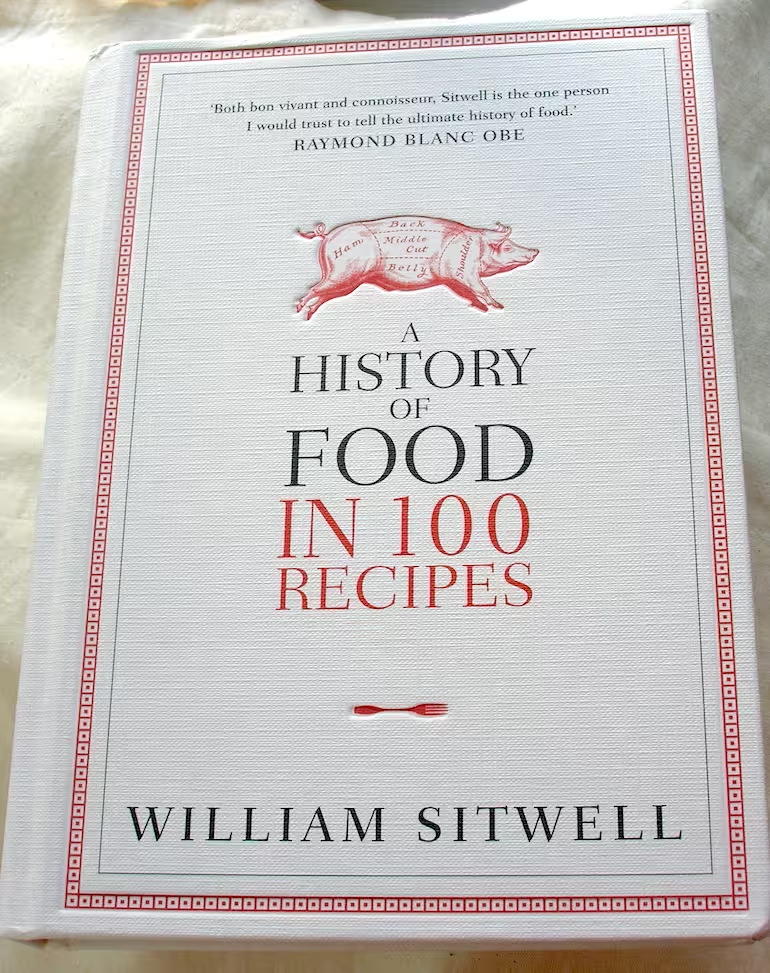
A History of Food in 100 Recipes
As the title suggests, A history of food in 100 recipes is a collection of stories elaborating on the history of food from a Western perspective. The book begins with a recipe for bread in Ancient Egypt from about 2000 BC and journeys through the ages right up to the present day where it ends with a recipe for meat fruit by Heston Blumenthal.
Each chapter commences with a recipe – of sorts. These are taken from sources of the period so are not necessarily easily understood or recognisable as a modern recipe. This then leads into the chapter proper which is connected in some way with the recipe.
The book is an engaging way of reconnecting with our food and where it comes from. It’s a treasure trove of fascinating facts, a history book written in a light, humorous and accessible style. I’m thoroughly enjoying it.
The Author William Sitwell is a food critic, journalist and presenter. He currently edits the food magazine Waitrose Kitchen amongst a plethora of other activities including gardening and being the resident expert on BBC TVs A Question of Taste. He has by no means covered the whole history of food, but has picked out the stories which particularly appeal to him.
History Of Food: Chocolate
Of course the first chapters I jumped to were the chocolate ones and I had two of these to revel in. Both interesting, both very different. The first was Hot Chocolate and recounts the well known “discovery” of chocolate by the conquistador Hernan Cortes.
During his stay with Montezuma he learnt the secrets of the cocoa bean. It was so highly prized, the Aztecs used it as currency. And he enjoyed many a brew of spiced frothing hot (sometimes cold) chocolate. Cocoa beans went back with him to Spain where the drink soon became revered for its health giving properties.
The second was Chocolate Cake, a chapter that was more about the first modern supermarkets than it was chocolate, but which featured an interesting chocolate cake recipe using bread flour. I shall certainly be trying that out at some future date. This chapter tells the remarkable story of Clarence Saunders in the USA and the founding of his chain of self service stores, Piggly Wiggly, in 1916.
History Of Food: Vegetarian
Being a vegetarian, I was fascinated to learn in the chapter Cauliflower & Cheese, that the Vegetarian Society was formed as far back as 1847 with a surprising 150 members signing up at its inception.
The first vegetarian cookbook was published as far back as 1812, Vegetarian cooking by a Lady (anonymous in other words). Amazingly, by 1897 there were seven vegetarian restaurants in London.
I’d always assumed that early Western vegetarians had chosen this diet for health reasons rather than ethics, but I was wrong. As far back as Pythagoras, vegetarians were also also motivated by animal welfare. This chapter is not for the faint hearted and perhaps should come with a warning; there are some very gruesome descriptions of animal brutality.
The book is a wonderful mix of facts, stories, interesting characters and recipes. It currently resides on my bedside table as it is a great book for dipping in and out of and the chapters are very short. By the time I get to bed, I can hardly keep my eyes open, so having a chapter which is just three to five pages long is ideal. Never has the term bite sized chunks seemed more appropriate.
Diner’s Dictionary
Now I do like to know the origin of words. Language is interesting and the language of food tells a long and complicated story about food and our relationship with other places and cultures. I was recently sent a review copy of the Diner’s Dictionary: word origins of food and drink by John Ayto. CT and I both dived in with relish.

This second edition is a small hardback which makes it easy to handle. So unlike other weightier tomes, you’re more likely to refer to it on a regular basis. With over 2,000 entries from Abernethy biscuit to zwieback, it is full of fascinating facts and like pottage you can dip in at will.
Pottage, interestingly is the predecessor of porridge, a phonetic change from t to r creating the oaty breakfast we love so much in this household. Who knew? A brief perusal will lead you down all sorts of interesting avenues and before you know it half an hour has gone.
It also makes excellent bedtime reading as proved by its strange and regular migration to CT’s bedside table. Biscuit lovers rest assured. The Alpha and Omega of this dictionary are both biscuits.
Chocolate Again
Strangely (or not), chocolate was the first word I looked up. I wasn’t expecting to discover anything I didn’t already know about this food of the gods, but I was curious to find out what sort of coverage it was given. I was gratified to see it was one of the longer entries.
In fact, I did learn something. The Aztecs made their cocoa drink with cold water rather than hot. It was the Spanish who introduced the use of hot water, a practice for which I’m very grateful as I warm my hands on my mug of cocoa on chilly evenings.
History Of Food: Flour Or Flower?
For all those keen bakers out there, the words flour and flower, I learnt were once identical. “The usage goes back to the early Middle Ages. When grain was milled, the most highly valued part, the meal, was characterised as the ‘flower’, the finest portion, as contrasted with the husks or bran”. This makes perfect sense, but I’d never thought of it before.
The first word CT looked for was “oca”, one of his wacky root crops; hooray, it was there. This, he took to be a good omen. However, he very soon revised his opinion downwards as the scientific name was not included.
On further perusal of the other entries, he was disappointed yet again. Turns out the book had no plant or animal scientific names anywhere. For a dictionary, he felt, this was quite a serious lack.
My copy of The Oxford Companion to Food by Alan Davidson, by contrast, includes scientific names of both plants and animals. The Diner’s Dictionary is also an Oxford University Press publication and we wondered if this represented a dumbing down of our great centres of learning.
With a recommended retail price of £12.99, this would make a fun and welcome addition to the food lover in your life’s Christmas stocking.
Other Food Books You Might Enjoy
- Crazy Water Pickled Lemons
- My First Cookbook
- The Leftovers Handbook
- The Oxford Companion To Sugar And Sweet
- World Of The Happy Pear
Keep in Touch
Thank you for visiting Tin and Thyme. If you have either The History Of Food In 100 Recipes or The Diner’s Dictionary, I’d love to hear about it in the comments below. Have you read either of them and if so what do you think?
For more delicious and nutritious recipes follow me on Twitter, Facebook, Instagram, Flipboard or Pinterest. And don’t forget to SUBSCRIBE to my weekly newsletter. Or why not join the conversation in our Healthy Vegetarian Whole Food Recipes Facebook Group?
If you’d like even more book reviews, follow the link and you’ll find I have quite a lot of them.
Choclette x
Thank you to Oxford University Press for my copy of The Diner’s Dictionary. I was not expected to write a positive review and all opinions expressed are my own.
That sounds like a fascinating book, would love to read it.
Sounds like a really interesting read and a well researched book.
A beautiful looking book. An excellent review.
A wonderful review and a great book x
As a history buff and foodie this is going to be a really interesting read for me. I can just imagine how exciting it is to prepare a dish served some 2000 years ago. I would definitely fancy a copy of this book.
Great review! This is a must-read, thanks for recommending this!
I often go to bed with a good cookery book to read but this sounds really interesting – I’d love to find out more about the history of food. 🙂
Looks like a very interesting book, lots of new things to learn in there!
Well I certainly need to get my hands on this book! It sounds really interesting, can’t believe the Vegetarian society was formed so long ago!
Fascinating sounding book!
Choclette, the soup recipe I linked to in my unphotogenic post was this one http://www.guardian.co.uk/lifeandstyle/2012/jul/13/basque-soup-bread-recipe-garlic from Dan Lepard. Didn’t the link work for you?
I am with Dom – I LOVE this book but am finding it so hard to write a succinct and good review….I am going to take a leaf out of your book and hone in on a recipe…..and then take it from there! Karen
Te he Karen, I’m happy to lead the way 😉
i’ve loved this book since I received a copy but am finding it really hard to review… yours in an excellent review… I think I must try and find a recipe and then use it… there are some really bizarre ones from it that i’m sure would go down well in Belleau Kitchen x
Thanks Dom, you can come again, the excellent word always goes down well. Bizarre Belleau Kitchen – bring it on 😉
Lots to keep you amused in that book!
Plenty indeed – when I can wrest it off CT that is 😉
It sounds like a very interesting book, I really enjoy reading about recipes and history of food.
The history of food is really the history of us and our culture, so it is a fascinating subject.
It’s a superb book Really I would have thought it would be a best seller instantly because it’s so readable.
Yes, it certainly ought to be Vanessa.
I think it’s great to know the history behind each food. Could shed some light on why foods are getting modified today.
You have a good point Ellen, sadly so many know so little about the food we grow and eat 🙁
Nice to read the review. Didn’t know what this book had in it as it’s not obvious on the cover. But it sounds really interesting. Will add to the reading list.
Hi May, this is most definitely worthy of being added to a reading list 🙂
Sounds like a fascinating book, but if I’m honest, I really want to know about that chocolate cake! You will be featuring it on your blog soon…I hope!
You are a woman after my own heart Debs! I can’t promise soon, but I will be featuring the chocolate cake at some point.
Lovely review of such an interesting book which re defined our view of a 5* ratng
I am really enjoying how all the reviews are picking out different things from the book. Makes me need to go and readed parts.
Yours is the only review I’ve seen so far Helen. Will have to look out for others.
It is interesting to learn about the start of the veggie society, but I don’t think this is one for me.
That’s OK Jac, it’s not compulsory 🙂
This book sounds fascinating Choclette. Amazing insight…I had no idea that there vegetarian restaurants so far back. I’d love to know what was on the menu…Is there information about that in the book?
It’s a really good read Debby and so much to learn. Sadly no menus provided. It did talk about the recipes in one of the earlier vegetarian cookbooks though – which were mostly boiled veg!