
Brown Sugar Aquafaba Meringues: Vegan Crunch Munch
Light and crunchy brown sugar aquafaba meringues are a complete delight. Eat on their own, top them with whipped coconut cream and berries, add to an Eton Mess style dessert or crumble over ice cream. They’re a vegan dream.
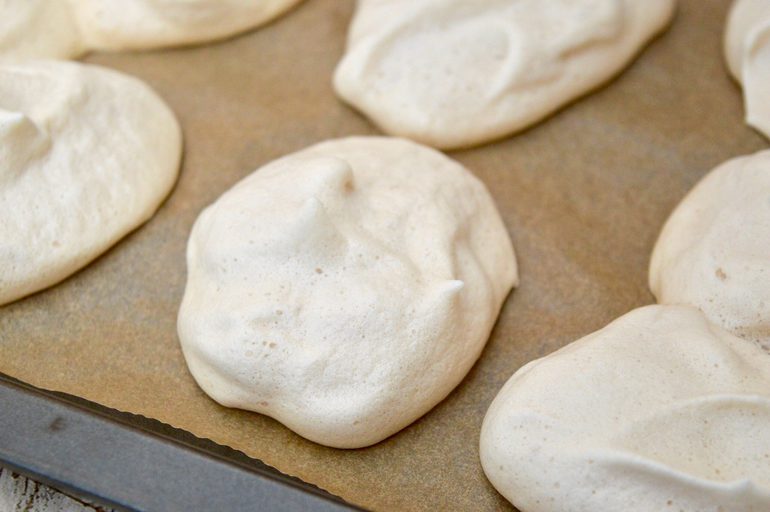
If you’ve not tried making aquafaba meringues before I urge you to give them a try. They’re a revelation. If you have made them before, why not try my brown sugar version?
What is Aquafaba?
Aquafaba is the water that chickpeas, beans and other pulses are cooked in. The clue’s in the name: aqua means water in latin and faba mean bean. It’s really useful stuff so it’s a shame to throw it away. Just drain it from a tin of pulses or reserve the water from your own cooked ones.
Egg Substitute
You can use it as a general egg substitute in vegan baking and it’s meant to make a good vegan mayonnaise too. I haven’t tried it though. Now I’ve perfected my own super quick and easy recipe for vegan mayonnaise, I’m reluctant to move on.
In recipes that use one egg, substitute three tablespoons (45 ml) aquafaba. For an egg white, use two tablespoons (30 ml).
If you want to use aquafaba for baking, it’s best to use unsalted water. Not only is the salted water salty, but it generally has a more powerful flavour that you don’t really want in your bakes. For these brown sugar aquafaba meringues, chickpea water is best.
Why Vegans Should Avoid White Sugar
As a whole food blogger, I’ve only ever used white sugar on rare occasions. But I was really quite shocked to discover recently that white sugar is often refined using animal bones. I suspect I’m not the only person who’s completely unaware of this.
The bones are charred and ground up into something called bone char. Bone char is then used to filter sugar to make it whiter.
This seems to be more of an issue in the US than it does here in the UK. Icing sugar is the main culprit here. If you want to avoid bone char sugars, however, it’s best to avoid any pure white sugars. You’ll be safe with certified organic sugars, muscovado sugar and anything from Billingtons.
Brown Sugar Aquafaba Meringues
I’ve heard that white sugar is the most reliable sugar to use when it comes to making meringues. But for the reasons given above, I’ve never tried it. I’ve used golden caster sugar, but these brown sugar aquafaba meringues are my favourite. They have a lovely caramel flavour and a good tan colour – well it is summer.
I use the aquafaba from one 400g tin of chickpeas, which usually comes out at around 180ml. But you may need to adjust quantities depending on how much you have available.

If you have a stand mixer, you’ll find making these brown sugar aquafaba meringues a complete breeze. The machine will do all the work for you. I wouldn’t recommend whisking by hand for this recipe though, as you’d need to be incredibly fit. This is because it takes ten minutes at high speed in a stand mixer to achieve a good stiff meringue.
For a rustic look dollop heaped tablespoonfuls of the raw meringue onto the baking tray. If you’re after something a bit fancier, you’ll need to get the piping bag out.
Some people say you can’t taste the difference between vegan meringues and ordinary ones, but that’s not the case in my experience. They do have a certain beany flavour, but you quickly get used to it. They’re still light, crisp and delicious.
Brown Sugar Aquafaba Meringues – Top Tips
It’s taken me a while to master aquafaba meringues. They are more fragile and temperamental to make than egg white meringues. I’ve had no problems whipping up the aquafaba into stiff peaks. I’ve even held the bowl over my head to make sure the mixture is stiff enough. But when the meringues started to cook, they collapsed and I was left with a sticky unusable goo.
So here are my top tips on how to make successful brown sugar aquafaba meringues.
Whisking Aquafaba Meringue
- Chickpea water works best. Make sure your chickpeas are from a tin of unsalted water.
- Use an electric mixer. If you have a stand mixer, so much the better as it takes about ten minutes to whisk to stiff peaks.
- Make sure your bowl is clean. Grease can kill a meringue.
- Whisk the aquafaba with a little cream of tartar to stabilise it.
- Use a soft light brown sugar such as light brown muscovado not a dark or lumpy one.
- Once the aquafaba starts to form peaks, add the sugar gradually, one spoonful at a time. Allow the sugar to get fully incorporated before you add the next spoonful.
- Unlike egg whites, you can’t over whip aquafaba meringue, so just keep going until you’re satisfied you have stiff peaks that hold their shape. You should be able to turn the bowl upside down without the meringue sliding out.
Baking Aquafaba Meringue
- Make sure you use baking parchment paper to line your baking trays. DON’T use silicone mats. I’m not a scientist, but I assume it’s to do with the insulation. They’re just too thick and cause the meringues to deflate. They were my downfall when I first tried to make aquafaba meringues.
- Either spoon the meringues onto the baking tray for a rustic look, or pipe them on if you prefer something a bit more uniform.
- Place the meringues well apart on the tray as the mixture will spread. This is a case of do as I say, not as I do. I have a terrible tendency to try and cram as many onto the tray as I can. As you can see from the photos, the result is a bit of a mess.
- Use a low oven temperature and bake for at least one and three quarter hours without opening the door. I’ve found the best meringues are those I bake in the centre of the oven. If they’re on the top shelf, they go a darker brown. Still delicious, but just not quite as good. At the bottom of the oven, they need longer to cook.
- Before turning the oven off, test one by peeling it off the paper and gently tapping the bottom. If it’s crisp, it’s good to go.
- Turn the oven off, but leave the meringues inside with the door slightly ajar until the oven is cold. This allows them to dry off a bit more.
- Once cool, either eat straight away or store in an airtight tin for up to 48 hours. If you leave them exposed to the air for long, they will soften.
Other Recipes For Vegan Bakes You Might Like
- Almond rhubarb loaf cake
- Chocolate chip cookies
- Chocolate self-saucing pudding
- Healthy pumpkin scones
- Homemade crackers
- Purple biscuits
Keep in Touch
Thanks for visiting Tin and Thyme. If you make these vegan brown sugar aquafaba meringues, I’d love to hear about it in the comments below. Do share photos on social media too and use the hashtag #tinandthyme, so I can spot them.
For more delicious and nutritious recipes follow me on Twitter, Facebook, Instagram, Flipboard or Pinterest. And don’t forget to SUBSCRIBE to my weekly newsletter. Or why not join the conversation in our Healthy Vegetarian Whole Food Recipes Facebook Group?
If you’d like more vegan recipes, follow the link and you’ll find I have quite a lot of them. All delicious, of course.
Choclette x
Brown Sugar Aquafaba Meringues. PIN IT.
Vegan Brown Sugar Meringues
Ingredients
- 180 ml aquafaba (6 fl oz or ¾ cup) from an unsalted tin of chickpeas
- ½ tsp cream of tartar
- 100 g light brown sugar (3 ½ oz or ½ cup (I use light brown muscovado))
Instructions
- Tip the aquafaba into a bowl or the bowl of your stand mixer. Make sure it's clean. Add the cream of tartar.180 ml aquafaba, ½ tsp cream of tartar
- Start on low speed and whisk until the aquafaba is foamy, then gradually increase the speed to high and whisk until soft peeks form.
- Whilst the mixer continues to whip at high speed, add a spoonful of sugar at a time. Make sure it’s well mixed before adding the next one.100 g light brown sugar
- Continue to whisk until the meringue is stiff and glossy. You should be able to turn the bowl upside down whilst the meringue stays put. It usually takes about ten minutes of continual whisking.
- Set your oven to 100℃ (212℉, Gas ¼).
- Scoop heaped tablespoons of the meringue onto baking trays lined with parchment baking paper. Allow room for spreading.
- Place in the centre of the oven and leave for at least 1 ¾ hours before opening the door. They usually take two hours, but I like to test mine just in case any are getting too dark.
- If the meringues are firm and crispy all over, they’re done. If not, continue to bake for a further fifteen minutes. Then test again.
- Once you’re happy they’re done, turn the oven off, but leave the meringues inside to dry and cool. Keep the oven door slightly ajar to allow any steam to escape.
- Once the oven and meringues are cold, serve immediately or store in an air tight tin.
Notes
Nutrition Estimate
Sharing
I’m sharing this recipe for vegan brown sugar aquafaba meringues with Recipes Made Easy for #CookBlogShare.
so yummy!! i love it! i ll definitely try it!!
I don’t know why I never thought to use brown sugar in meringues for that caramel flavour. Nice idea.
That’s what I love about blogging, there’s always new ways of doing things to find.
Such a fascinating thing that aquafaba, it’s quite magical and your meringues look very good.
It really is a bit like magic Janice – now I’ve finally mastered them.
can i switch to something cream of tartar?
Hi Darya. Cream of tarter helps to give the meringues a bit of stability, but not everyone uses it. You can just use aquafaba and sugar. I’ve found it helps though. You could try adding an extra 10g of sugar instead. But I haven’t tried this, so it’s over to you. Let me know how you get on.
I keeping meaning to try these every time I open a tin of chickpeas! One day I will – and thanks for the note about silicon as that is my go to go baking but I will keep this in that back of my head now. Thanks for linking up to #CookBlogShare. Michelle x
They’re definitely worth making Michelle. Not only are they wonderfully light, but it almost feels like magic.
Didn’t know about the silicone, so thanks! These look just like egg white meringues, pretty awesome and love the brown sugar/caramel touch! Yum!
Once I finally got them to work, I was pretty impressed. Who’d of though a bit of water could do that?
I love the sound of adding brown sugar to meringues (i’m also slightly horrified by what goes into some white sugar!) #CookBlogShare
Meringues made with brown sugar are lovely Helen. As for the white sugar, I was quite shocked too.
I love making meringue with brown sugar, it gives it such a fab flavour!
Yes, the caramel notes make them extra special I reckon.
I have found that AF meringues don’t taste so beany the next day. We also like piping them onto oven trays and I’ve been amazed at how nicely they hold the shape! It is a while since I have made them – I once made maple syrup meringues with eggs and have wondered if that would work with aqua faba. I haven’t tried brown sugar but like the sound!
I think you’re probably right Johanna, they were a bit more delicious the next day. But I often find that when I’m cooking. I think the process of cooking makes my tastebuds a teensy bit jaded. I always used to make my meringues with maple syrup. Had completely forgotten until you just reminded me. Not sure it would work very well with AF though, as it’s so delicate.
Wow, so many great ways to use these little bites. I would love some crushed up on top of yogurt. The flavour profile sounds absolutely wonderful.
They’re absolutely perfect for crushing. And I have to confess we may have had an Eton Mess! Always make ours with a mix of yoghurt and cream.
Ive not been aware that animal bones are sometimes used to refine white sugar, but i do prefer to use golden caster sugar and granulated to the white as I not only like the fact it is less refined but also tastes nicer too in my opinion. Im also a huge fan of light muscovado sugar for the flavour so I imagine it would make these meringues taste lovely. Given what you have said it might be worth noting that some brands of brown sugars are in fact white sugars coloured with caramel. For this reason I always suggest people use muscovado sugar as that is never refined which ever brand you use.
Thank you for linking to CookBlogShare
Like you, I’ve always recommended muscovado sugar. I did mean to mention about the potential colouring of brown sugars so thanks for the reminder. Though I don’t think it’s as much of an issue as it used to be.
What a delicious recipe this is. I am saving it to make it again. and again. Kids loved it too. Thank you so much for all the extra information and tips given, all so good to know.
Thank you. It’s a lovely recipe for sure and not nearly as sweet as some I’ve seen. Great for entertaining – when we can actually do that again.
These turned out delicious! Thanks so much for the tip to use baking parchment paper and not silicone mats. I never would’ve guessed!
Sadly I didn’t guess Amanda and had to learn the hard way. Still, I guess learning from one’s mistakes is what cooking’s all about really.
I made some for my husband last month and surprisingly that he LOVED them and didn’t know it’s made with chickpea water. These look super crunchy and light!
Oh what fun that he didn’t know. I don’t think anyone would they were made with chickpea water, but I reckon they’d be able to tell the difference if they tried a vegan and non-vegan one together.